
Choose the halogen which is most reactive towards reaction in the given compounds (A, B, C, & D):
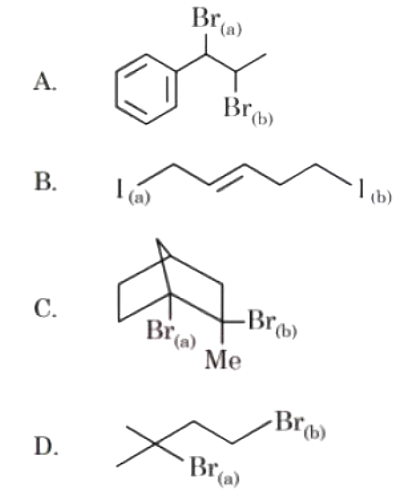
- A
A-Br(a); B-I(a); C-Br(b); D-Br(a)
- B
A-Br(a); B-I(a); C-Br(a); D-Br(a)
- C
A-Br(b); B-I(b); C-Br(b); D-Br(b)
- D
A-Br(a); B-Br(a); C-Br(a); D-I(a)
Choose the halogen which is most reactive towards reaction in the given compounds (A, B, C, & D):
A-Br(a); B-I(a); C-Br(b); D-Br(a)
A-Br(a); B-I(a); C-Br(a); D-Br(a)
A-Br(b); B-I(b); C-Br(b); D-Br(b)
A-Br(a); B-Br(a); C-Br(a); D-I(a)
Correct answer:A
Standard Method
Given: We must choose the halogen most reactive towards the reaction in compounds A, B, C, and D.
Find: The correct option listing the most reactive halogen position in each compound.
For an reaction, the rate depends on the stability of the carbocation formed after the leaving group departs. Better leaving groups and more stable carbocations favor the reaction.
The extracted explanation states:
Thus, the most reactive halogens are:
Therefore, the correct option is A.
Carbocation Stability Basis
Given: Reactivity towards depends mainly on carbocation stability and leaving group ability.
Find: Which labeled halogen leaves most readily in each structure.
Use the principle:
Also, among halides, iodide is generally a better leaving group than bromide.
Applying the extracted solution statements:
Hence the sequence matches: A-Br(a); B-I(a); C-Br(b); D-Br(a)
Therefore, the correct option is A.
Assuming only leaving group ability decides reactivity is incorrect because carbocation stability is the primary factor. Compare the carbocation formed after halogen departure before ranking the sites.
Ignoring resonance stabilization in benzylic systems leads to a wrong choice for compound A. A benzylic carbocation is much more stable than an ordinary primary carbocation.
Treating all primary halides as equally unreactive in is incorrect here. A better leaving group such as iodine can still make one position more reactive than another.
Get unlimited AI-adaptive practice, mastery tracking, and an AI tutor that explains every step — free to start.