
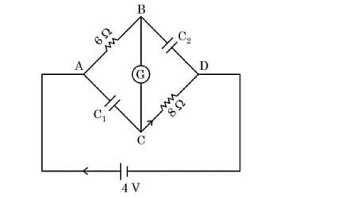
In this figure, the resistance of the coil of galvanometer is . The emf of the cell is . The ratio of potential difference across and is:
- A
- B
- C
- D
In this figure, the resistance of the coil of galvanometer is . The emf of the cell is . The ratio of potential difference across and is:
Correct answer:C
Standard Method
Given: The resistance of the galvanometer coil is and the cell emf is .
Find: The ratio of potential differences across and .
Apply Kirchhoff’s laws. Using the given circuit, calculate the currents and potential drops across and .
The required ratio is:
Therefore, the ratio of potential differences across and is . The correct option is C.
Using the option label from the solution without checking the numerical value is incorrect because the page marks option A while the computed ratio shown is . Match the value with the listed options, which gives option C.
Ignoring the galvanometer resistance of is incorrect because it affects the current distribution in the bridge network. Include the galvanometer branch while applying Kirchhoff’s laws.
Taking the ratio of resistances directly as the ratio of potential differences is incorrect because the circuit is not a simple series divider. First determine branch currents or potential drops using circuit laws, then form the ratio .
Get unlimited AI-adaptive practice, mastery tracking, and an AI tutor that explains every step — free to start.