
As shown in the figure, the voltmeter reads across a resistor. The resistance of the voltmeter is _____ .
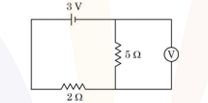
As shown in the figure, the voltmeter reads across a resistor. The resistance of the voltmeter is _____ .
Correct answer:20
Standard Method
Given: A source, a resistor, and a branch containing a resistor in parallel with a voltmeter of resistance . The voltmeter reads .
Find: The resistance of the voltmeter.
Since the resistor and the voltmeter are in parallel, the potential difference across each is .
Current through the resistor is
The source is , so the remaining potential drop across the resistor is
Hence the total current through the series resistor is
Using junction law at the parallel branch,
So,
This is the current through the voltmeter. Therefore,
Therefore, the resistance of the voltmeter is .
Equivalent Resistance Method
Given: The voltmeter of resistance is in parallel with the resistor, and this parallel combination is in series with .
Find: The value of .
The equivalent resistance of the parallel part is
So total resistance is
The total current from the source is
Because the parallel branch has a voltage of , the series resistor has a drop of , so total current is also
Equating and solving gives .
Therefore, the resistance of the voltmeter is .
Treating the voltmeter and the resistor as if they were in series. They are connected across the same two nodes, so they are in parallel. Use equal voltage across both branches, not equal current.
Using the full across the resistor. The voltmeter reading shows that the parallel branch has only across it. The remaining is across the resistor.
Assuming an ideal voltmeter with infinite resistance. This question specifically asks for the voltmeter resistance, so the meter draws current and must be treated as a finite resistor in parallel.
Get unlimited AI-adaptive practice, mastery tracking, and an AI tutor that explains every step — free to start.