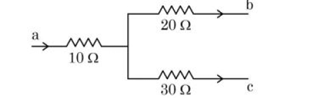
Figure shows a part of an electric circuit. The potentials at points , , and are , , and respectively. The current through the resistor will be:
- A
- B
- C
- D
Figure shows a part of an electric circuit. The potentials at points , , and are , , and respectively. The current through the resistor will be:

Correct answer:C
Standard Method
Given: Potentials at , , and . The resistors are , , and .
Find: The current through the resistor.
Let potential of the junction be volts. Using junction law,
From the solution,
and
Solving for ,
Therefore, current through the resistor is
Therefore, the current through the resistor is . The correct option is C.
Using the potential difference across the wrong resistor branch is a common mistake. The resistor is connected between the junction and point , so its current must be found using the junction potential and , not the potentials at and .
Assuming the three resistors are in simple series is incorrect because the circuit splits at the junction into two branches. After the resistor, current divides between the and paths.
Taking the given point potentials as direct voltage drops across each resistor is wrong. Potentials are measured with respect to a common reference, so the voltage across a resistor is the difference between the potentials at its two ends.
Get unlimited AI-adaptive practice, mastery tracking, and an AI tutor that explains every step — free to start.