
A planet has double the mass of the Earth. Its average density is equal to that of the Earth. An object weighing on Earth will weigh on that planet:
- A
- B
- C
- D
A planet has double the mass of the Earth. Its average density is equal to that of the Earth. An object weighing on Earth will weigh on that planet:
Correct answer:A
Standard Method
Given: The planet has mass and average density equal to Earth, so .
Find: The weight of an object on the planet in terms of .
Using density,
Since ,
Substituting ,
So,
Hence,
The acceleration due to gravity is
Therefore,
Substituting and ,
Thus,
Weight is . Since the mass of the object remains the same,
Therefore, the object will weigh on the planet. The correct option is A.
Using proportionality of gravity with density and radius
Given: The planet has double Earth’s mass and the same average density.
Find: Weight on the planet in terms of .
For a spherical planet of uniform average density,
when density is constant. Since the new planet has mass , its radius becomes
So,
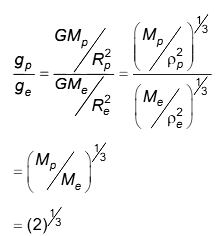
Now,
Hence,
Therefore,
and so the weight becomes
Therefore, the correct answer is .
Using only and ignoring the change in radius. This is wrong because gravity depends on both mass and radius as . First find how the radius changes from the density condition.
Assuming the radius also doubles when the mass doubles. This is wrong because equal density implies , so the radius scales as , not directly as mass.
Confusing mass of the object with its weight. The object’s mass remains constant, while its weight changes because changes. Compute the new first, then multiply by the same object mass.
Get unlimited AI-adaptive practice, mastery tracking, and an AI tutor that explains every step — free to start.