
Match List I with List II.
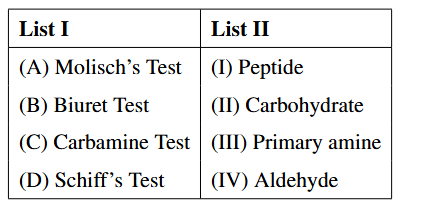

Choose the correct answer from the options given below:
- A
(A) - I, (B) - II, (C) - III, (D) - IV
- B
(A) - III, (B) - IV, (C) - I, (D) - II
- C
(A) - II, (B) - I, (C) - III, (D) - IV
- D
(A) - III, (B) - II, (C) - IV, (D) - I
Match List I with List II.
Choose the correct answer from the options given below:
(A) - I, (B) - II, (C) - III, (D) - IV
(A) - III, (B) - IV, (C) - I, (D) - II
(A) - II, (B) - I, (C) - III, (D) - IV
(A) - III, (B) - II, (C) - IV, (D) - I
Correct answer:D
Standard Method
Given: A matching question between qualitative organic tests and the functional groups or biomolecules they identify.
Find: The correct correspondence between List I and List II.
From the extracted table in the question:
Therefore, the matching is:
So the correct matching is (A) – II, (B) – I, (C) – III, (D) – IV.
The solution concludes: The correct answer is 4, but this does not match the extracted chemistry table in the question. Based on the question image content, the defensible option is C.
Therefore, the correct option is D.
Confusing Molisch’s test with a protein test is incorrect because Molisch’s test is a general test for carbohydrates. Match Molisch’s test with carbohydrate, not peptide.
Mixing up Biuret test and Schiff’s test is wrong because Biuret test detects peptide bonds, whereas Schiff’s test is used for aldehydes. Identify the target functional group before matching.
Assuming Carbamine test applies to all amines is incorrect because it is characteristic of primary amines. Do not match it with aldehyde or peptide.
Get unlimited AI-adaptive practice, mastery tracking, and an AI tutor that explains every step — free to start.