
Match List I with List II.
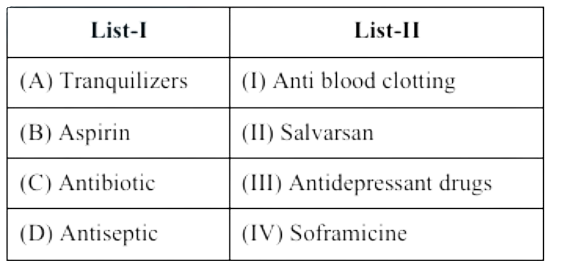

- A
(A) - IV, (B) - II, (C) - I, (D) - III
- B
(A) - II, (B) - III, (C) - I, (D) - IV
- C
(A) - III, (B) - I, (C) - II, (D) - IV
- D
(A) - II, (B) - IV, (C) - I, (D) - III
Match List I with List II.
(A) - IV, (B) - II, (C) - I, (D) - III
(A) - II, (B) - III, (C) - I, (D) - IV
(A) - III, (B) - I, (C) - II, (D) - IV
(A) - II, (B) - IV, (C) - I, (D) - III
Correct answer:C
Standard Method
Given: A match-the-following question on double salts and coordination compounds.
Find: The correct matching option.
Double salts dissociate completely into their constituent ions in water, whereas coordination compounds do not dissociate fully because they form coordination complexes.
From the solution analysis:
Thus the correct identification corresponds to the matching given in option C.
Therefore, the correct option is C.
Classification Logic
Given: Examples of salts and complexes are to be matched.
Find: Which option correctly classifies them.
The key idea is:
Using this:
So the arrangement matches the one listed under option C.
Therefore, the correct option is C.
Treating every hydrated salt as a double salt is incorrect because the presence of water of crystallization alone does not decide the classification. Instead, check whether the compound dissociates completely into simple ions in water.
Assuming ammonia-containing compounds are always double salts is wrong. Ligands like NH often indicate coordination behavior, so identify whether a coordination sphere is formed.
Confusing double salts with coordination compounds leads to wrong matching. A double salt loses its separate identity in solution, while a coordination compound retains complex ions in solution.
Get unlimited AI-adaptive practice, mastery tracking, and an AI tutor that explains every step — free to start.