
In the following reaction, ‘A’ is:
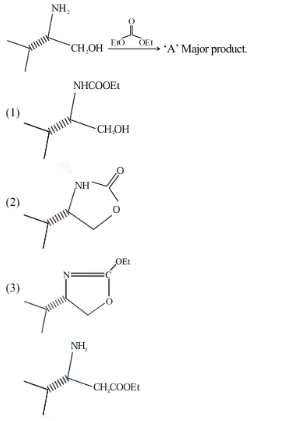

- A
- B
Option not available in scraped HTML
- C
Option not available in scraped HTML
- D
Option not available in scraped HTML
In the following reaction, ‘A’ is:
Option not available in scraped HTML
Option not available in scraped HTML
Option not available in scraped HTML
Correct answer:A
Standard Method
Given: The reaction involves an amino alcohol substrate and formation of a major product A.
Find: Identify the structure of A.
The solution states that carbamates are commonly formed by reaction of primary amines with chloroformates. It further explains that the primary amine group attacks the carbonyl carbon of the reagent, leading to formation of a carbamate group.
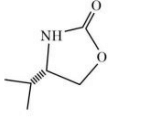
Thus, the major product A is:
the solution explicitly concludes that the correct option is A and identifies option (1) as the product. Since the listed options are unavailable, the answer is taken from the solution.
Therefore, the correct option is A.
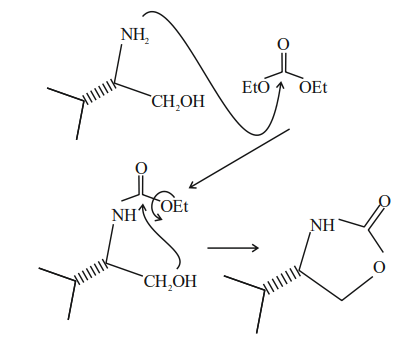
Mechanistic Interpretation
Given: A substrate containing and groups reacts to give major product A.
Find: The identity of the product formed.
From the extracted explanation:
So the reaction does not leave the amine unchanged; instead it converts it into a carbamate functionality. The answer image corresponds to the cyclic carbamate shown as option A.
Hence, the correct option is A.
Assuming the group reacts first is incorrect because the solution identifies nucleophilic attack by the group on the carbonyl carbon. First check which site is described as the attacking nucleophile.
Treating the product as a simple substitution product is wrong. The extracted mechanism shows cyclization, so the final product is a cyclic carbamate, not merely an acyclic derivative.
Relying on the answer key '(2)' would be misleading here. The solution explicitly says The Correct Option is A, so the worked solution must take precedence.
Get unlimited AI-adaptive practice, mastery tracking, and an AI tutor that explains every step — free to start.