
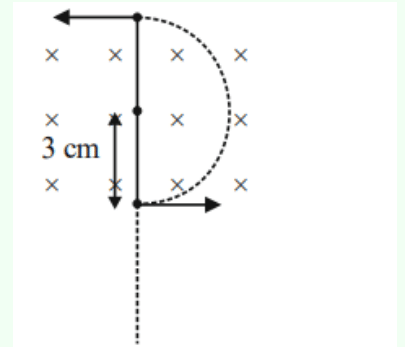
A charge particle of accelerated by a potential difference of enters a region of uniform magnetic field of magnitude at right angle to the direction of field. The charge particle completes semicircle of radius inside magnetic field. The mass of the charge particle is _____ \times kg.
NVAMediumJEE 2023Force on Moving Charge
JEE Physics 2023 Question with Solution
Answer
Correct answer:144
Step-by-step solution
Standard Method
Given: charge of particle = , potential difference = , magnetic field = , radius of semicircle = .
Find: mass of the particle in the form .
A charged particle accelerated through potential difference gains kinetic energy:
Also, in a magnetic field, the radius of circular path is:
So,
Substituting in the energy equation:
Hence,
Now substitute:
Therefore, the required value is 144.
Using combined magnetic radius and energy relations
Given: the particle first gains speed due to electric potential difference and then moves perpendicular to a uniform magnetic field.
Find: the numerical value multiplying .
From acceleration through potential difference:
From circular motion in magnetic field:
Rearranging,
Squaring both sides,
Using
we get
Substitute numerical values:
Therefore, the answer is 144.
Common mistakes
Using instead of . This inverts the magnetic-radius relation and gives a completely wrong mass. Always start from magnetic force providing centripetal force.
Forgetting that the particle is accelerated through a potential difference, so the gained kinetic energy is . Using only magnetic formulas without the energy relation leaves too many unknowns.
Not converting units correctly: to , to , and to . SI conversion is essential before substitution.
Practice more Force on Moving Charge questions
Get unlimited AI-adaptive practice, mastery tracking, and an AI tutor that explains every step — free to start.
Related questions
- A current carrying solenoid is placed vertically and a particle of mass m with charge Q is released from…Easy · JEE 2026
- A monochromatic light is incident on a metallic plate having work function. An electron, emitted normally to…Medium · JEE 2025
- An electron with mass m with an initial velocity (t = 0) v = v0 (v0 0) enters a magnetic field B = B j. If…Easy · JEE 2025
- Given below are two statements: one is labelled as Assertion A and the other is labelled as Reason R.…Easy · JEE 2025
- A particle of charge 1.6 C and mass 16 g is present in a strong magnetic field of 6.28 T. The particle is…Easy · JEE 2025
- Uniform magnetic fields of different strengths B1 and B2, both normal to the plane of the paper, exist as…Medium · JEE 2025