MCQEasyJEE 2023Gauss's Law Applications

JEE Physics 2023 Question with Solution

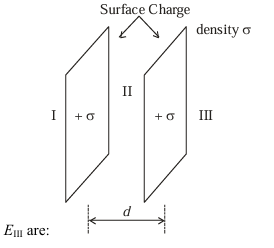
Let σ\sigma be the uniform surface charge density of two infinite thin plane sheets shown in the figure. Then the electric fields in three different regions EIE_I, EIIE_{II} and EIIIE_{III} are:

Two parallel infinite thin plane sheets carrying positive surface charge density sigma, with regions I, II, and III marked and separation d shown between the sheets.Two positively charged parallel plane sheets with surface charge density sigma, normal direction indicated, regions I, II, III labeled, and distance d between sheets.
  • A

    EI=2σε0n^,EII=0,EIII=2σε0n^\vec{E}_I = \frac{2\sigma}{\varepsilon_0} \hat{n}, \quad \vec{E}_{II} = 0, \quad \vec{E}_{III} = \frac{2\sigma}{\varepsilon_0} \hat{n}

  • B

    EI=0,EII=σε0n^,EIII=0\vec{E}_I = 0, \quad \vec{E}_{II} = \frac{\sigma}{\varepsilon_0} \hat{n}, \quad \vec{E}_{III} = 0

  • C

    EI=σ2ε0n^,EII=0,EIII=σ2ε0n^\vec{E}_I = \frac{\sigma}{2\varepsilon_0} \hat{n}, \quad \vec{E}_{II} = 0, \quad \vec{E}_{III} = \frac{\sigma}{2\varepsilon_0} \hat{n}

  • D

    EI=σε0n^,EII=0,EIII=σε0n^\vec{E}_I = -\frac{\sigma}{\varepsilon_0} \hat{n}, \quad \vec{E}_{II} = 0, \quad \vec{E}_{III} = \frac{\sigma}{\varepsilon_0} \hat{n}

Answer

Correct answer:D

Step-by-step solution

Standard Method

Given: Two infinite thin plane sheets each have uniform surface charge density σ\sigma.

Find: The electric field in regions II, IIII and IIIIII.

For one infinite plane sheet, the magnitude of electric field on either side is

E=σ2ε0E = \frac{\sigma}{2\varepsilon_0}

and for a positively charged sheet, the field is directed away from the sheet.

Assuming the right-hand side is along n^\hat{n}:

EI=σ2ε0(n^)+σ2ε0(n^)=σε0n^\vec{E}_I = \frac{\sigma}{2\varepsilon_0}(-\hat{n}) + \frac{\sigma}{2\varepsilon_0}(-\hat{n}) = -\frac{\sigma}{\varepsilon_0}\hat{n} EII=0\vec{E}_{II} = 0 EIII=σ2ε0(n^)+σ2ε0(n^)=σε0n^\vec{E}_{III} = \frac{\sigma}{2\varepsilon_0}(\hat{n}) + \frac{\sigma}{2\varepsilon_0}(\hat{n}) = \frac{\sigma}{\varepsilon_0}\hat{n}

Therefore, the field configuration matches option D.

The solution labels the correct option as C, but the extracted working clearly corresponds to option D in the listed options.

Superposition of Fields

Given: Both sheets carry equal positive surface charge density σ\sigma.

Find: Net electric field in each region.

Use the principle of superposition. Each sheet produces field of magnitude

σ2ε0\frac{\sigma}{2\varepsilon_0}

on both sides.

  • In region II, both fields point to the left, i.e. along n^-\hat{n}, so they add.
  • In region IIII, the field due to left sheet is along +n^+\hat{n} while that due to right sheet is along n^-\hat{n}, so they cancel.
  • In region IIIIII, both fields point along +n^+\hat{n}, so they add.

Hence,

EI=σε0n^,EII=0,EIII=σε0n^\vec{E}_I = -\frac{\sigma}{\varepsilon_0}\hat{n}, \qquad \vec{E}_{II} = 0, \qquad \vec{E}_{III} = \frac{\sigma}{\varepsilon_0}\hat{n}

Thus, the correct option is D.

Common mistakes

  • Adding the two fields in region IIII instead of cancelling them. Between two identical positively charged sheets, the fields are equal in magnitude and opposite in direction. Resolve direction first, then add vectors.

  • Using σε0\frac{\sigma}{\varepsilon_0} for the field of a single infinite sheet. The field due to one infinite sheet is σ2ε0\frac{\sigma}{2\varepsilon_0}. The factor of 22 appears only after adding contributions from both sheets in outer regions.

  • Ignoring the sign of the normal direction n^\hat{n}. The vector answer depends on direction, so region II must be along n^-\hat{n} and region IIIIII along +n^+\hat{n}. Always choose a reference direction before superposition.

Practice more Gauss's Law Applications questions

Get unlimited AI-adaptive practice, mastery tracking, and an AI tutor that explains every step — free to start.

Related questions