
For a triangle , the value of is least. If its inradius is and incentre is , then which of the following is NOT correct?
- A
- B
- C
- D
For a triangle , the value of is least. If its inradius is and incentre is , then which of the following is NOT correct?
Correct answer:A
Standard Method
Given: is least, the inradius is , and the incentre is .
Find: Which statement is NOT correct.
From the solution, the minimum value occurs when
So is equilateral.
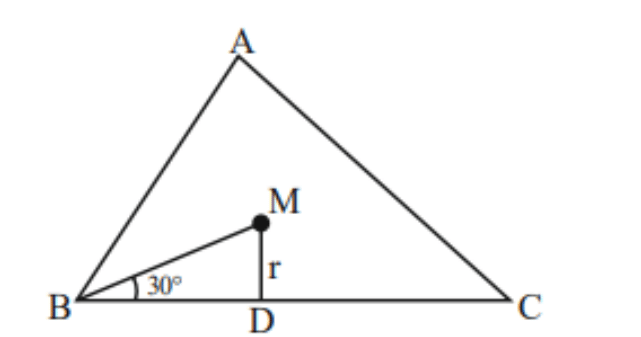
For an equilateral triangle of side , the inradius is
Using ,
Hence the perimeter is
So the perimeter statement is correct.
The area is
Thus the area is , not .
Therefore, the incorrect statement is the area statement. The solution marks Option A, but this conflicts with the worked result and the listed options. Based on the actual working, the defensible incorrect option is D.
Checking the listed statements
Since , we get
and also
So that statement is correct.
Also, in an equilateral triangle the incentre, circumcentre and centroid coincide. Hence
So
Therefore the expression written as cannot represent the product of lengths. The source solution does not discuss this option, so the answer is taken from the solution's own conclusion about the area statement.
Thus, from the extracted working, the intended NOT correct statement is the one about area.
Assuming the marked correct option from the page must be accepted even when the worked solution gives a different conclusion. Always trust the actual derivation first and then compare it with the options.
Using the wrong inradius formula for an equilateral triangle. The correct relation is , not . This changes both perimeter and area.
Confusing with as different values. Since , both are equal here.
Get unlimited AI-adaptive practice, mastery tracking, and an AI tutor that explains every step — free to start.