
For the given circuit, in the steady state, ......... .
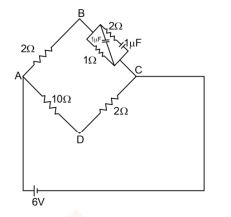
For the given circuit, in the steady state, ......... .
Correct answer:1
Standard Method
Given: In the steady state, the capacitor behaves as an open circuit.
Find: The value of .
So the circuit simplifies to:
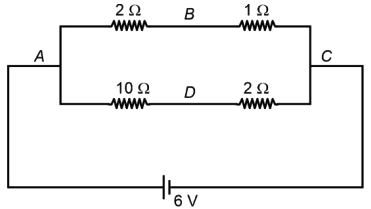
From the simplified circuit,
Using the potential relation shown in the solution,
Hence,
Therefore, the required voltage difference is .
Open-Circuit Capacitor View
Given: The circuit contains a capacitor and a source.
Find: The steady-state voltage difference between points and .
In steady state, the capacitor behaves like an open circuit, so no current flows through the capacitor branch. The remaining network has two branches between the source terminals.
Top branch resistance:
Bottom branch resistance:
So the branch currents are
Potential drop from to is
Potential drop from to is
Therefore the magnitude of the potential difference is
So, the correct answer is .
Treating the capacitor as a short circuit in steady state is incorrect because for DC steady state it behaves as an open circuit. First remove the capacitor branch, then analyze the resistor network.
Adding all resistors into one series combination is wrong because the top and bottom paths are separate branches across the same source. Compute current in each branch independently.
Using signed difference instead of magnitude is incorrect because the question asks for . After finding the two node potentials, take the absolute value.
Get unlimited AI-adaptive practice, mastery tracking, and an AI tutor that explains every step — free to start.