
The correct increasing order of the ionic radii is:
- A
- B
- C
- D
The correct increasing order of the ionic radii is:
Correct answer:D
Standard Method
Given: The ions , , and are to be arranged in increasing order of ionic radii.
Find: The correct increasing order of ionic size.
All four ions are isoelectronic species. In isoelectronic species, ionic size decreases as nuclear charge increases. Hence, ionic size is inversely proportional to nuclear charge:
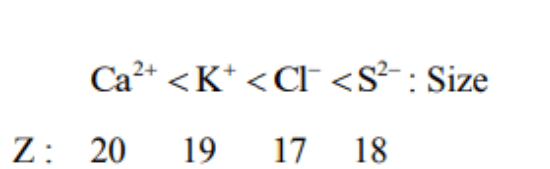
Among these ions, the nuclear charge is highest for and lowest for . Therefore, the ionic radius increases in the order:
Therefore, the correct option is D. The solution also contains a conflicting label "The Correct Option is A", but the worked order clearly matches option D.
Using Isoelectronic Trend
Given: and are isoelectronic.
Find: Their increasing order of ionic radii.
For isoelectronic species, the number of electrons is the same, so the deciding factor is the nuclear charge. Greater nuclear charge pulls the same electron cloud more strongly and decreases size.
Here, the relevant nuclear charges are:
So, size increases as decreases:
Hence, the correct increasing order is .
Assuming cations are always smaller and anions are always larger without checking that the ions are isoelectronic. Here, the correct comparison must be based on nuclear charge for species having the same number of electrons.
Using atomic number order incorrectly. For isoelectronic species, larger means stronger attraction on the same electron cloud, so the radius becomes smaller, not larger.
Missing the discrepancy in the displayed solution label. The text says option A, but the worked order shown is , which matches option D. Always trust the actual working over a mislabeled option tag.
Get unlimited AI-adaptive practice, mastery tracking, and an AI tutor that explains every step — free to start.