For hydrogen atom, and are the wavelengths corresponding to the transitions and , respectively, as shown in the figure. The ratio of and is . The value of is:
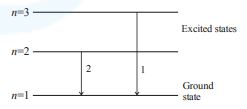
For hydrogen atom, and are the wavelengths corresponding to the transitions and , respectively, as shown in the figure. The ratio of and is . The value of is:

Correct answer:27
Standard Method
Given: Two hydrogen atom transitions produce wavelengths and as shown in the figure.
Find: The value of in .
Use the Rydberg formula for hydrogen:
For transition :
For transition :
Now,
Comparing with , we get .
Therefore, the value of is .
Using the extracted working
Given: the solution states the correct answer is .
Find: Verify the ratio using the transition values shown.
From the extracted working:
and
Hence,
So, in the form , we obtain .
Therefore, the numerical answer is .
Using the ratio of inverse wavelengths directly as the ratio of wavelengths. This is wrong because is inversely proportional to the Rydberg expression. After finding , invert before comparing and .
Reading the energy-level diagram incorrectly. This is wrong because the initial and final levels determine the value of and in the Rydberg formula. First identify each transition carefully from the figure, then substitute the quantum numbers.
Substituting the higher level first and lower level second without maintaining the emitted-photon convention. This can give a negative value for . Use the lower final level term minus the higher initial level term so that the wavelength remains positive.
Get unlimited AI-adaptive practice, mastery tracking, and an AI tutor that explains every step — free to start.