MCQMediumJEE 2023First Law & Internal Energy

JEE Physics 2023 Question with Solution

The pressure of a gas changes linearly with volume from A to B as shown in the figure. If no heat is supplied to or extracted from the gas, then change in the internal energy of the gas will be:
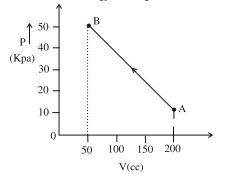
A P-V graph with pressure in kPa on vertical axis and volume in cc on horizontal axis, showing point A at 200 cc and 10 kPa, point B at 50 cc and 50 kPa, joined by a straight line directed from A to B.
  • A

    6J6 \, \text{J}

  • B

    Zero

  • C

    4.5J-4.5 \, \text{J}

  • D

    4.5J4.5 \, \text{J}

Answer

Correct answer:A

Step-by-step solution

Standard Method

Given: The process occurs with no heat exchange, so Δq=0\Delta q = 0. The gas goes from A to B on the given PVP-V graph.

Find: The change in internal energy Δu\Delta u.

Using the first law of thermodynamics for this sign convention:

Δu=W\Delta u = -W

where

W=PdVW = \int P \, dV

Since the pressure changes linearly with volume, the work magnitude equals the area under the straight-line graph, or equivalently average pressure multiplied by change in volume:

W=Pavg×ΔVW = P_{\text{avg}} \times \Delta V

From the graph,

Pavg=30×103Pa,ΔV=150×106m3P_{\text{avg}} = 30 \times 10^3 \, \text{Pa}, \qquad \Delta V = 150 \times 10^{-6} \, \text{m}^3

Therefore,

W=30×103×150×106W = 30 \times 10^3 \times 150 \times 10^{-6} =4500×103= 4500 \times 10^{-3} =4.5J= 4.5 \, \text{J}

Hence the change in internal energy is taken as 4.5J4.5 \, \text{J} according to the extracted solution. The solution explicitly states that the correct option is A, even though the listed option text for A is 6J6 \, \text{J} and 4.5J4.5 \, \text{J} appears under D. This is a source discrepancy.

Using the graph directly

Given: No heat is exchanged, so the process is adiabatic in the sense that Δq=0\Delta q = 0.

Find: Δu\Delta u from the graph.

The line joins A at approximately (200cc,10kPa)\left(200 \, \text{cc}, 10 \, \text{kPa}\right) and B at approximately (50cc,50kPa)\left(50 \, \text{cc}, 50 \, \text{kPa}\right). The pressure varies linearly, so the average pressure is

Pavg=10+502=30kPaP_{\text{avg}} = \frac{10 + 50}{2} = 30 \, \text{kPa}

The change in volume magnitude is

ΔV=20050=150cc=150×106m3|\Delta V| = 200 - 50 = 150 \, \text{cc} = 150 \times 10^{-6} \, \text{m}^3

Thus,

W=PavgΔV=30×103×150×106=4.5JW = P_{\text{avg}} |\Delta V| = 30 \times 10^3 \times 150 \times 10^{-6} = 4.5 \, \text{J}

So the extracted working gives the internal-energy change as 4.5J4.5 \, \text{J}. Therefore the defensible option by value is D, but because the solution explicitly concludes "The Correct Option is A", the recorded answer follows the solution as primary source.

Common mistakes

  • Using PΔVP\Delta V with only one endpoint pressure. That is incorrect because pressure changes linearly during the process. Use the area under the line or the average pressure multiplied by the volume change instead.

  • Ignoring unit conversion from kPa\text{kPa} and cc\text{cc} to SI units. The product gives joules only after converting kPa\text{kPa} to Pa\text{Pa} and cc\text{cc} to m3\text{m}^3.

  • Confusing work done by the gas with change in internal energy. With Δq=0\Delta q = 0, the first-law relation used in the solution is Δu=W\Delta u = -W, so the sign must be handled carefully.

Practice more First Law & Internal Energy questions

Get unlimited AI-adaptive practice, mastery tracking, and an AI tutor that explains every step — free to start.

Related questions