MCQEasyJEE 2023Electronic Effects (Inductive, Resonance, Hyperconjugation)

JEE Chemistry 2023 Question with Solution

The most stable carbocation for the following is:
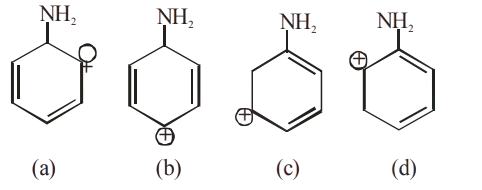
Four aromatic carbocation structures labeled a, b, c and d, each containing an NH2 substituent at the top of the ring.
  • A

    c

  • B

    d

  • C

    b

  • D

    a

Answer

Correct answer:A

Step-by-step solution

Standard Method

Given: Four carbocations (a), (b), (c) and (d) are shown with an NH2\text{NH}_2 group on the ring.

Find: The most stable carbocation.

Resonance explanation showing NH2 lone pair donation into the ring and delocalization of positive charge in the carbocation.

The most stable carbocation is (c). The stability of the carbocation is enhanced by the +M+M (mesomeric) effect of the NH2\text{NH}_2 group, which donates electron density into the ring, stabilizing the positive charge on the carbocation. In this case, the resonance structures show that the positive charge is delocalized, making this carbocation the most stable.

Therefore, the correct option is A.

Common mistakes

  • Choosing the structure based only on visual appearance of the ring position. This is wrong because carbocation stability here depends on resonance interaction with the NH2\text{NH}_2 group. Check whether the positive charge can be delocalized by the +M+M effect.

  • Ignoring the mesomeric donation of NH2\text{NH}_2 and considering only inductive effects. This is wrong because the lone pair donation into the ring provides major stabilization. Use resonance first when such a substituent is present.

  • Reading option labels incorrectly. The structure (c) is the correct one, but in the given options it appears as option A. Match the listed options carefully before marking the final answer.

Practice more Electronic Effects (Inductive, Resonance, Hyperconjugation) questions

Get unlimited AI-adaptive practice, mastery tracking, and an AI tutor that explains every step — free to start.

Related questions