
As shown in figure, a cuboid lies in a region with electric field N/C. The magnitude of charge within the cuboid is C. The value of is _____ (if dimensions of cuboid are )
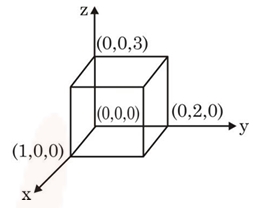
As shown in figure, a cuboid lies in a region with electric field N/C. The magnitude of charge within the cuboid is C. The value of is _____ (if dimensions of cuboid are )
Correct answer:12
Standard Method
Given: Electric field is
The cuboid extends from to , to , and to .
Find: The value of if the enclosed charge magnitude is .
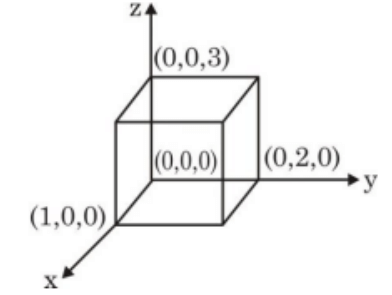
Using Gauss's law in differential form, the net flux is obtained from the divergence of the field over the cuboid. From the extracted working,
Now apply Gauss's law:
So,
Hence,
Therefore, the value of is .
Using divergence explicitly
Given:
Find: Enclosed charge magnitude in the form .
Compute divergence:
Integrate over the cuboid volume:
with , , .
By Gauss's law,
Therefore, the magnitude is
So the required value is .
Using the electric field directly instead of its divergence for enclosed charge. Gauss's law for enclosed charge depends on net flux, not on the field at one point. Compute or total outward flux through faces.
Forgetting that the question asks for the magnitude of charge. The flux comes out negative, so , but the required value is .
Ignoring the cuboid dimensions while integrating. The limits , , determine the total flux. Missing these bounds gives an incorrect value of enclosed charge.
Get unlimited AI-adaptive practice, mastery tracking, and an AI tutor that explains every step — free to start.