NVAMediumJEE 2023Kirchhoff's Laws & Circuits

JEE Physics 2023 Question with Solution

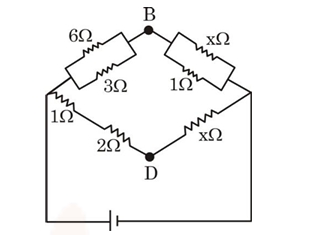
If the potential difference between B and D is zero, the value of xx is 1nΩ\frac{1}{n} \, \Omega. The value of nn is ........

Circuit diagram of a resistive network with nodes B at top and D at bottom, left branch having 6 ohm and 3 ohm near B, 1 ohm and 2 ohm near D, and right branches each labeled x ohm, with a battery across outer terminals.

Answer

Correct answer:2

Step-by-step solution

Standard Method

Given: The potential difference between B and D is zero.

Find: The value of nn if x=1nΩx = \frac{1}{n} \, \Omega.

For points B and D to be at the same potential in this resistive network, the voltage division along the two branches must balance.

Using the relation given in the solution:

23=x+1x\frac{2}{3} = \frac{x+1}{x}

Now solve for xx:

2x=3(x+1)2x = 3(x + 1) 2x=3x+32x = 3x + 3 x=0.5=12x = 0.5 = \frac{1}{2}

Since x=1nΩx = \frac{1}{n} \, \Omega, we get

1n=12\frac{1}{n} = \frac{1}{2}

Therefore, n=2n = 2.

Thus, the required numerical value is 22.

Common mistakes

  • Using the condition of zero current instead of equal potential at B and D is incorrect. Zero potential difference means the two nodes are equipotential, so the branch voltage drops must balance. Use the balancing condition between the resistor ratios.

  • Solving 23=x+1x\frac{2}{3} = \frac{x+1}{x} incorrectly by cross-multiplication can lead to a wrong value of xx. Multiply carefully first, then isolate xx step by step.

  • Reporting x=12Ωx = \frac{1}{2} \, \Omega as the final answer is wrong because the question asks for nn, not xx. After finding x=12x = \frac{1}{2}, compare with x=1nx = \frac{1}{n} to obtain n=2n = 2.

Practice more Kirchhoff's Laws & Circuits questions

Get unlimited AI-adaptive practice, mastery tracking, and an AI tutor that explains every step — free to start.

Related questions