
If the potential difference between B and D is zero, the value of is . The value of is ........
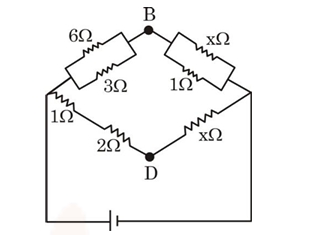
If the potential difference between B and D is zero, the value of is . The value of is ........
Correct answer:2
Standard Method
Given: The potential difference between B and D is zero.
Find: The value of if .
For points B and D to be at the same potential in this resistive network, the voltage division along the two branches must balance.
Using the relation given in the solution:
Now solve for :
Since , we get
Therefore, .
Thus, the required numerical value is .
Using the condition of zero current instead of equal potential at B and D is incorrect. Zero potential difference means the two nodes are equipotential, so the branch voltage drops must balance. Use the balancing condition between the resistor ratios.
Solving incorrectly by cross-multiplication can lead to a wrong value of . Multiply carefully first, then isolate step by step.
Reporting as the final answer is wrong because the question asks for , not . After finding , compare with to obtain .
Get unlimited AI-adaptive practice, mastery tracking, and an AI tutor that explains every step — free to start.