MCQMediumJEE 2023Skew Lines & Shortest Distance

JEE Mathematics 2023 Question with Solution

The line 1\ell_1 passes through the point (2,6,2)\left(2, 6, 2\right) and is perpendicular to the plane 2x+y2z=102x + y - 2z = 10. Then the shortest distance between the line 1\ell_1 and the line

x+12=y+43=z2\frac{x+1}{2} = \frac{y+4}{-3} = \frac{z}{2}

is:

  • A

    77

  • B

    193\frac{19}{3}

  • C

    192\frac{19}{2}

  • D

    99

Answer

Correct answer:D

Step-by-step solution

Standard Method

Given: The line L1L_1 passes through A(2,6,2)A(2,6,2) and is perpendicular to the plane 2x+y2z=102x+y-2z=10.

Find: The shortest distance between L1L_1 and L2:x+12=y+43=z2L_2: \frac{x+1}{2}=\frac{y+4}{-3}=\frac{z}{2}.

Since L1L_1 is perpendicular to the plane, its direction ratios are the normal vector of the plane. Therefore,

L1:x22=y61=z22L_1: \frac{x-2}{2}=\frac{y-6}{1}=\frac{z-2}{-2}

and

L2:x+12=y+43=z2L_2: \frac{x+1}{2}=\frac{y+4}{-3}=\frac{z}{2}

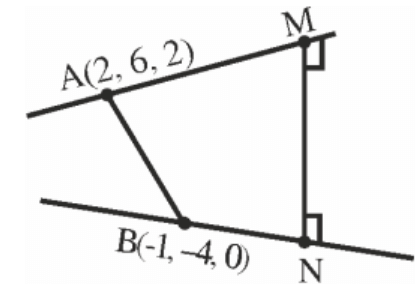
Take a point A(2,6,2)A(2,6,2) on L1L_1 and a point B(1,4,0)B(-1,-4,0) on L2L_2. Then

AB=(12)i^+(46)j^+(02)k^=3i^10j^2k^\overrightarrow{AB}=(-1-2)\hat{i}+(-4-6)\hat{j}+(0-2)\hat{k}=-3\hat{i}-10\hat{j}-2\hat{k}

The direction vectors of the two lines are

d1=2i^+j^2k^,d2=2i^3j^+2k^\vec{d_1}=2\hat{i}+\hat{j}-2\hat{k}, \qquad \vec{d_2}=2\hat{i}-3\hat{j}+2\hat{k}

Their cross product is

d1×d2=i^j^k^212232=4i^8j^8k^\vec{d_1}\times\vec{d_2}=\begin{vmatrix} \hat{i} & \hat{j} & \hat{k} \\ 2 & 1 & -2 \\ 2 & -3 & 2 \end{vmatrix}=-4\hat{i}-8\hat{j}-8\hat{k}

So,

d1×d2=(4)2+(8)2+(8)2=144=12\left|\vec{d_1}\times\vec{d_2}\right|=\sqrt{(-4)^2+(-8)^2+(-8)^2}=\sqrt{144}=12

Now,

AB(d1×d2)=(3)(4)+(10)(8)+(2)(8)=12+80+16=108\overrightarrow{AB}\cdot(\vec{d_1}\times\vec{d_2})=(-3)(-4)+(-10)(-8)+(-2)(-8)=12+80+16=108

Hence the shortest distance between the skew lines is

d=AB(d1×d2)d1×d2=10812=9d=\frac{\left|\overrightarrow{AB}\cdot(\vec{d_1}\times\vec{d_2})\right|}{\left|\vec{d_1}\times\vec{d_2}\right|}=\frac{108}{12}=9

Therefore, the shortest distance is 99. The solution states option C, but the working clearly gives 99, which matches option D.

Sketch of two skew lines with points A(2,6,2) and B(-1,-4,0), and perpendicular segment MN showing the shortest distance between them.

Common mistakes

  • Using the plane equation directly as the line equation is incorrect. Because the line is perpendicular to the plane, its direction ratios come from the plane's normal vector 2,1,2\langle 2,1,-2 \rangle; the line still must be written through the point (2,6,2)\left(2,6,2\right).

  • Choosing the shortest distance formula for parallel lines is wrong here. These two lines are skew lines, so use d=AB(d1×d2)d1×d2d=\frac{|\overrightarrow{AB}\cdot(\vec{d_1}\times\vec{d_2})|}{|\vec{d_1}\times\vec{d_2}|} instead.

  • Errors in the cross product sign are common. A wrong sign in d1×d2\vec{d_1}\times\vec{d_2} changes the numerator or denominator. Expand the determinant carefully and then take magnitude at the end.

Practice more Skew Lines & Shortest Distance questions

Get unlimited AI-adaptive practice, mastery tracking, and an AI tutor that explains every step — free to start.

Related questions