MCQEasyJEE 2023LCR Circuits & Resonance

JEE Physics 2023 Question with Solution

For the given figures, choose the correct option:
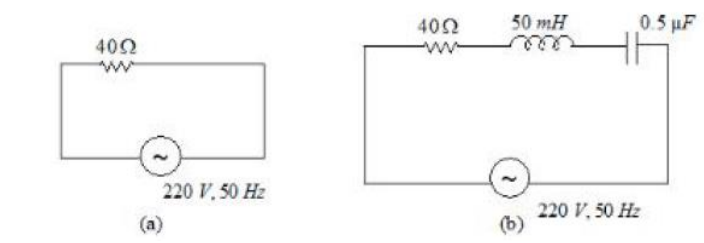
Two AC circuits labeled (a) and (b). Circuit (a) has a 40 ohm resistor with 220 V, 50 Hz source. Circuit (b) has 40 ohm resistor, 50 mH inductor, 0.5 microfarad capacitor, and 220 V, 50 Hz source.
  • A

    The rms current in circuit (b) can never be larger than that in (a)

  • B

    The rms current in figure (a) is always equal to that in figure (b)

  • C

    The rms current in circuit (b) can be larger than that in (a)

  • D

    At resonance, current in (b) is less than that in (a)

Answer

Correct answer:B

Step-by-step solution

Standard Method

Given: Circuit (a) has only a resistor. Circuit (b) has a resistor, an inductor, and a capacitor. The solution states:

Za=RZ_a = R Ia=VRI_a = \frac{V}{R}

Find: Compare the rms currents in the two circuits.

For circuit (b), the total impedance is

Zb=R2+(XLXC)2Z_b = \sqrt{R^2 + (X_L - X_C)^2}

Since XLXC0|X_L - X_C| \ge 0, we have

ZbZaZ_b \ge Z_a

Therefore, the rms current in circuit (b) is

Ib=VZbI_b = \frac{V}{Z_b}

so

IbIaI_b \le I_a

Thus, the rms current in circuit (b) can never exceed that in circuit (a).

This conclusion matches option A from the listed options. However, the solution explicitly states The Correct Option is B, which is inconsistent with the shown working and the provided option texts.

Common mistakes

  • Assuming that adding an inductor and capacitor always increases current is incorrect. In a series AC circuit, current depends on total impedance, so you must compare ZbZ_b with RR first.

  • Ignoring the reactive term (XLXC)(X_L - X_C) is wrong because it contributes to impedance magnitude. Use Z=R2+(XLXC)2Z = \sqrt{R^2 + (X_L - X_C)^2} before comparing currents.

  • Confusing resonance with reduced current is incorrect here. At resonance, XL=XCX_L = X_C, so the reactive part vanishes and the impedance becomes just RR, making the current equal to that of the pure resistor circuit.

Practice more LCR Circuits & Resonance questions

Get unlimited AI-adaptive practice, mastery tracking, and an AI tutor that explains every step — free to start.

Related questions