
Match List I with List II:
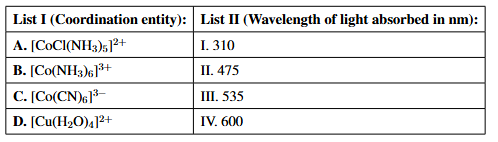
- A
A-IV, B-I, C-III, D-II
- B
A-III, B-II, C-I, D-IV
- C
A-III, B-I, C-II, D-IV
- D
A-II, B-III, C-IV, D-I
Match List I with List II:
A-IV, B-I, C-III, D-II
A-III, B-II, C-I, D-IV
A-III, B-I, C-II, D-IV
A-II, B-III, C-IV, D-I
Correct answer:A
Standard Method
Given: Match the coordination entities with the wavelength of light absorbed.
Find: The correct correspondence between List I and List II.
From the extracted solution table:
Also, the solution uses:
So,
Hence the crystal field splitting energy is inversely proportional to the absorbed wavelength, and stronger ligands correspond to larger splitting and smaller absorbed wavelength.
Therefore, the correct matching is A-III, B-II, C-I, D-IV.
The correct option is A.
Ligand Strength and Absorption Trend
Given: and therefore absorbed energy increases as wavelength decreases.
Find: Which wavelength corresponds to each coordination entity.
Among the ligands present, is the strongest field ligand, so should absorb the smallest wavelength, which is .
Aqua ligand is relatively weak field, so corresponds to the largest wavelength, which is .
The remaining values from the provided solution table are:
Thus,
So the correct option is A. Note that this conclusion follows the solution and differs from the answer key.
Assuming larger absorbed wavelength means larger crystal field splitting. This is wrong because , so larger splitting corresponds to smaller wavelength. Compare energies inversely with wavelength.
Ignoring the spectrochemical series. This is wrong because ligand strength determines crystal field splitting. Use the relative field strengths such as being stronger than , and being weaker.
Following the answer key key without checking the worked solution. Here the provided solution table explicitly gives the mapping. Always prioritize the actual solution working when there is a conflict.
Get unlimited AI-adaptive practice, mastery tracking, and an AI tutor that explains every step — free to start.