NVAMediumJEE 2023Refraction & Lenses

JEE Physics 2023 Question with Solution

An object is placed on the principal axis of a convex lens of focal length 10cm10 \, \text{cm} as shown. A plane mirror is placed on the other side of the lens at a distance of 20cm20 \, \text{cm}. The image produced by the plane mirror is 5cm5 \, \text{cm} inside the mirror. The distance of the object from the lens is:
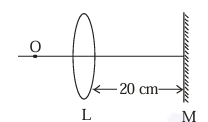
Object O on the left of a convex lens L, with a plane mirror M on the right, separated by 20 cm along the principal axis.

Answer

Correct answer:30

Step-by-step solution

Standard Method

Given: focal length of convex lens is 10cm10 \, \text{cm}. The plane mirror is at a distance of 20cm20 \, \text{cm} from the lens. The image produced by the plane mirror is 5cm5 \, \text{cm} inside the mirror.

Find: the distance of the object from the lens.

Ray diagram showing object O, convex lens, intermediate image I1 at 15 cm from lens, plane mirror at 20 cm, and final mirror image 5 cm behind the mirror.

Since the image formed by the plane mirror is 5cm5 \, \text{cm} behind the mirror, the object for the mirror must be 5cm5 \, \text{cm} in front of the mirror. Therefore, the image formed by the lens before reflection is at a distance of

205=15cm20 - 5 = 15 \, \text{cm}

from the lens.

Now apply the lens formula:

1v1u=1f\frac{1}{v} - \frac{1}{u} = \frac{1}{f}

With v=15cmv = 15 \, \text{cm} and f=10cmf = 10 \, \text{cm},

1151u=110\frac{1}{15} - \frac{1}{-u} = \frac{1}{10} 1u=110115\Rightarrow \frac{1}{u} = \frac{1}{10} - \frac{1}{15} 1u=130\frac{1}{u} = \frac{1}{30}

So,

u=30cmu = 30 \, \text{cm}

Therefore, the distance of the object from the lens is 30cm30 \, \text{cm}.

Mirror-image Interpretation

Given: the mirror forms an image 5cm5 \, \text{cm} inside itself.

Find: the original object distance from the lens.

For a plane mirror, image distance behind the mirror equals object distance in front of the mirror. Hence the point from which rays reach the mirror must be 5cm5 \, \text{cm} in front of it.

Since the lens and mirror are 20cm20 \, \text{cm} apart, the lens must first form an image at

205=15cm20 - 5 = 15 \, \text{cm}

to the right of the lens.

Using the lens relation,

1f=1v1u\frac{1}{f} = \frac{1}{v} - \frac{1}{u} 110=1151u\frac{1}{10} = \frac{1}{15} - \frac{1}{u} 1u=110115=130-\frac{1}{u} = \frac{1}{10} - \frac{1}{15} = \frac{1}{30}

The sign indicates the usual Cartesian convention for an object on the left side of the lens, so the required distance magnitude is 30cm30 \, \text{cm}.

Therefore, the final answer is 3030.

Common mistakes

  • Taking the mirror image to be 5cm5 \, \text{cm} from the lens instead of 5cm5 \, \text{cm} from the mirror is incorrect. The plane mirror relation must be applied at the mirror surface. First locate the point 5cm5 \, \text{cm} in front of the mirror, then convert it to distance from the lens.

  • Using the lens formula with incorrect sign convention is a common error. For a real object on the left of the convex lens, the object distance is negative in Cartesian convention. Use the formula consistently and interpret the final magnitude as the asked distance.

  • Assuming the lens image forms at 20+5=25cm20 + 5 = 25 \, \text{cm} from the lens is wrong. A plane mirror forms the image behind itself by the same distance as the object lies in front, so the lens image must be 5cm5 \, \text{cm} in front of the mirror, not beyond it.

Practice more Refraction & Lenses questions

Get unlimited AI-adaptive practice, mastery tracking, and an AI tutor that explains every step — free to start.

Related questions