
The resistance of a wire is . If it's stretched to times of its original length, its new resistance will be:
- A
(1)
- B
(2)
- C
(3)
- D
(4)
The resistance of a wire is . If it's stretched to times of its original length, its new resistance will be:
(1)
(2)
(3)
(4)
Correct answer:A
Standard Method
Given: The initial resistance of the wire is and the wire is stretched to times its original length.
Find: The new resistance after stretching.
The solution states that the volume of wire remains constant during stretching.
So,
Since the new length is , we get
Using resistance relation,
For the stretched wire,
Therefore, the new resistance is . The correct option is A.
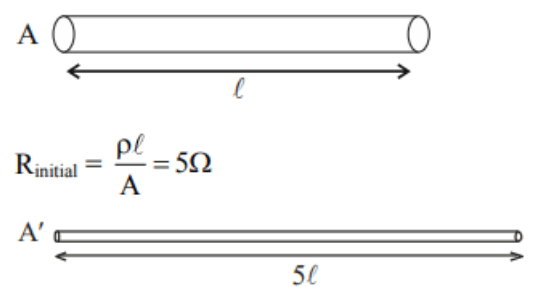
Why resistance increases by a factor of 25
Given: The wire length becomes while material remains the same, so is unchanged.
Find: How the resistance changes.
Since volume is constant,
Resistance depends directly on length and inversely on area:
After stretching, length becomes times and area becomes times. Hence,
So the resistance becomes times the original value.
Therefore, the correct option is A. Note that the raw options list labels as option C, but the solution explicitly concludes option A and computes .
Students often assume resistance is only proportional to length and multiply by to get . This is wrong because stretching also reduces the cross-sectional area. Use and constant volume together.
A common mistake is to keep the area unchanged after stretching. That is incorrect because for the same wire, volume remains constant, so increasing length must decrease area. First apply .
Some students use the option numbering from the question list instead of the resolved answer from the solution. Here the numerical value is , but the source has a labeling mismatch. Always trust the worked solution first.
Get unlimited AI-adaptive practice, mastery tracking, and an AI tutor that explains every step — free to start.