
Match List I with List II:
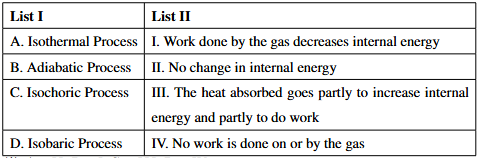
Choose the correct answer from the options given below :
- A
A-II, B-I, C-III, D-IV
- B
A-II, B-I, C-IV, D-III
- C
A-I, B-II, C-IV, D-III
- D
A-I, B-II, C-III, D-IV
Match List I with List II:
Choose the correct answer from the options given below :
A-II, B-I, C-III, D-IV
A-II, B-I, C-IV, D-III
A-I, B-II, C-IV, D-III
A-I, B-II, C-III, D-IV
Correct answer:B
Standard Method
Given: Match thermodynamic processes in List I with the correct statements in List II.
Find: The correct correspondence between A, B, C, D and I, II, III, IV.
For an ideal gas,
So internal energy depends only on temperature change.
For isothermal process, temperature remains constant, so
Hence,
Therefore, A (\to) II.
For adiabatic process,
Using the first law of thermodynamics,
So,
If work is done by the gas, , hence . Therefore, work done by the gas decreases internal energy. So B (\to) I.
For isochoric process, volume remains constant, hence no work is done:
Therefore, C (\to) IV.
For isobaric process,
Also,
So the heat absorbed is used partly to increase internal energy and partly to do work. Therefore, D (\to) III.
Thus the correct matching is A-II, B-I, C-IV, D-III.
The correct option is B.
Process-wise Interpretation
Given: Four thermodynamic processes and four statements.
Find: The correct one-to-one matching.
This gives:
So the correct option is B.
Confusing isothermal with adiabatic. In an isothermal process, temperature remains constant, so for an ideal gas . Do not assume there; that condition belongs to the adiabatic process.
Assuming adiabatic means internal energy does not change. That is incorrect because only means no heat exchange. Use the first law to get when work is done by the gas.
Forgetting that in an isochoric process volume is constant. Since , no boundary work is done. Do not match isochoric with partial work done; match it with zero work.
Get unlimited AI-adaptive practice, mastery tracking, and an AI tutor that explains every step — free to start.