
The energy levels of an atom is shown in figure. Which one of these transitions will result in the emission of a photon of wavelength ?
Given ()
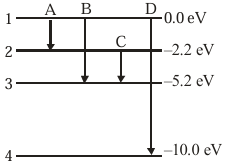
- A
B
- B
A
- C
C
- D
D
The energy levels of an atom is shown in figure. Which one of these transitions will result in the emission of a photon of wavelength ?
Given ()
B
A
C
D
Correct answer:D
Standard Method
Given: The transition energies are , , , and .
Find: Which transition emits a photon of wavelength .
Use
For the listed transitions:
This matches the given wavelength.
Therefore, the correct transition is D.
Using Planck relation explicitly
Given: , and for transition D, .
Find: Whether this gives .
Using
Substitute :
This gives
Hence the emitted photon corresponds to transition D.
The solution also contains a discrepancy where one heading says the correct option is A, but the worked values clearly show the correct transition is D. Since the option list is arranged as A: B, B: A, C: C, D: D, the correct option is D.
Using instead of . This reverses the proportionality and gives an incorrect wavelength. Always start from the photon energy relation .
Comparing the given wavelength directly with energy values in eV. Wavelength and energy are different physical quantities. First convert using or the shortcut .
Ignoring the option-label remapping. The raw options are arranged as B, A, C, D, so after finding transition D, the marked answer must be the option containing D, not the first listed transition mentioned in the solution heading.
Get unlimited AI-adaptive practice, mastery tracking, and an AI tutor that explains every step — free to start.