
Match List I with List II:
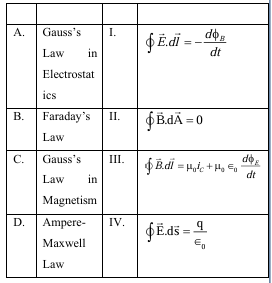
Choose the correct answer from the options given below:
- A
A-IV, B-I, C-II, D-III
- B
A-I, B-II, C-III, D-IV
- C
A-III, B-IV, C-I, D-II
- D
A-II, B-III, C-IV, D-I
Match List I with List II:
Choose the correct answer from the options given below:
A-IV, B-I, C-II, D-III
A-I, B-II, C-III, D-IV
A-III, B-IV, C-I, D-II
A-II, B-III, C-IV, D-I
Correct answer:A
Standard Method
Given: A matching question on electromagnetic laws and their integral forms.
Find: The correct correspondence between List I and List II.
Using the definitions of the laws:
Gauss's Law of electrostatics
So A matches IV.
Faraday's law
So B matches I.
Gauss's law of magnetism
So C matches II.
Ampere-Maxwell law
So D matches III.
Therefore, the correct matching is A-IV, B-I, C-II, D-III.
The solution states "The Correct Option is B", but the worked matching and final answer both give A-IV, B-I, C-II, D-III, which corresponds to option A in the provided options. Hence the defensible correct option is A.
Law Identification by Equation Form
Given: Four named laws and four equations.
Find: Which law corresponds to which integral equation.
Identify each by its characteristic quantity:
it is Gauss's Law in electrostatics.
it is Faraday's Law.
it is Gauss's Law in magnetism.
it is Ampere-Maxwell Law.
Hence,
So the correct option is A.
Confusing a closed surface integral with a closed line integral. This is wrong because Gauss laws use surface integrals, while Faraday and Ampere-Maxwell laws use line integrals. First identify whether the equation contains or versus .
Interchanging the two Gauss laws. This is wrong because electrostatics gives , whereas magnetism gives . Check both the field symbol and the right-hand side.
Missing the negative sign in Faraday's law. This is wrong because electromagnetic induction is represented by . Use the sign carefully to distinguish it from other Maxwell equations.
Get unlimited AI-adaptive practice, mastery tracking, and an AI tutor that explains every step — free to start.