
Match items of Row I with those of Row II: Row I:
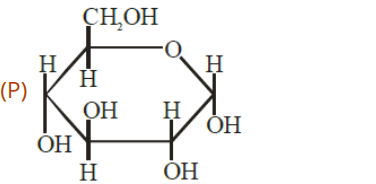
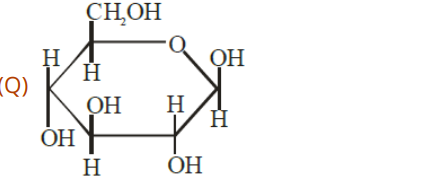
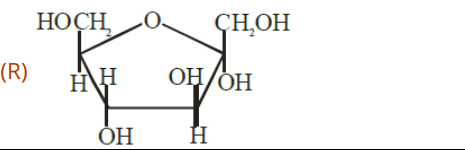
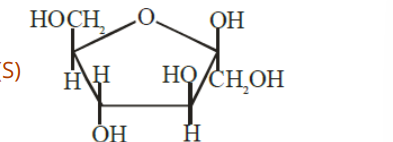
Row II:
- A
(1) P iv, Q iii, R i, S ii
- B
(2) P i, Q ii, R iii, S iv
- C
(3) P iii, Q iv, R ii, S i
- D
(4) P iii, Q iv, R i, S ii
Match items of Row I with those of Row II: Row I:
Row II:
(1) P iv, Q iii, R i, S ii
(2) P i, Q ii, R iii, S iv
(3) P iii, Q iv, R ii, S i
(4) P iii, Q iv, R i, S ii
Correct answer:D
Standard Method
Given: Four carbohydrate ring structures P, Q, R, S are to be matched with -D-(-)-Fructofuranose, -D-(-)-Fructofuranose, -D-(+)-Glucopyranose, and -D-(+)-Glucopyranose.
Find: The correct matching option.
From the given identification in the solution:
This is based on the ring size and anomeric configuration:
Therefore, the correct matching is P iii, Q iv, R i, S ii.
The correct option is D.
Ring Size and Anomer Analysis
Given: Structures P, Q, R, S.
Find: Which structures correspond to the named anomers.
So the complete match is:
Hence, the correct option is D.
Confusing pyranose with furanose. This is wrong because glucopyranose has a six-membered ring while fructofuranose has a five-membered ring. First count the ring members before assigning the sugar form.
Using the wrong anomeric carbon. This is incorrect because the anomeric carbon is C1 in glucose but C2 in fructose. Check the correct carbon before deciding between and .
Reversing and configurations. This leads to a wrong match because the distinction depends on the position of the OH group relative to the plane at the anomeric carbon. Compare the OH orientation carefully for each structure.
Get unlimited AI-adaptive practice, mastery tracking, and an AI tutor that explains every step — free to start.