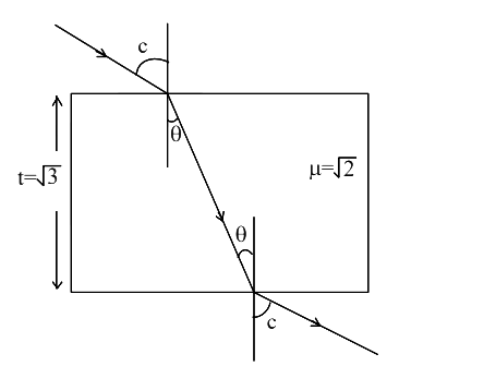
A ray of light is incident from air on a glass plate having thickness 5cm and refractive index 2. The angle of incidence of a ray is equal to the critical angle for glass-air interface. The lateral displacement of the ray when it passes through the plate is <10−2cm:
(Given sin15∘=0.26)
A
0.52cm
B
0.45cm
C
0.48cm
D
0.50cm
Answer
Correct answer:A
Step-by-step solution
Standard Method
Given: thickness of glass plate t=5cm, refractive index μ=2, and angle of incidence is equal to the critical angle.
Find: lateral displacement of the ray through the plate.
For the glass-air interface, the critical angle θc is given by
sinθc=μ1
So,
sinθc=21⟹θc=45∘
Hence the angle of incidence is i=45∘.
Using Snell's law at the first surface,
sinr=2sin45∘=21/2=21
Therefore,
r=30∘
The lateral displacement through a parallel-sided slab is
x=tsin(i−r)secr
Substituting the values,
x=5×sin(45∘−30∘)×sec30∘x=5×sin15∘×sec30∘
Using sin15∘=0.26 and sec30∘=32,
x=5×0.26×32x=35×0.52=0.52cm
Therefore, the lateral displacement is 0.52cm. The correct option is A.
Common mistakes
Using the critical angle formula incorrectly as sinθc=μ. This is wrong because for glass to air, sinθc=μ1. First find θc from the reciprocal of refractive index.
Taking the refracted angle inside the slab as 45∘. This is wrong because Snell's law must still be applied at the first surface. Use sinr=μsini to get r=30∘.
Using an incorrect slab formula for lateral displacement. The displacement is not simply ttan(i−r) here. Use the standard relation x=tsin(i−r)secr for a parallel glass plate.
Practice more Refraction & Lenses questions
Get unlimited AI-adaptive practice, mastery tracking, and an AI tutor that explains every step — free to start.