
Choose the correct representation of conductometric titration of benzoic acid vs sodium hydroxide.
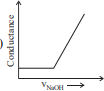
- A
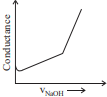
- B
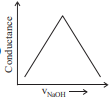
- C
- D
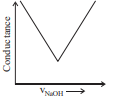
Choose the correct representation of conductometric titration of benzoic acid vs sodium hydroxide.
Correct answer:B
Standard Method
Given: conductometric titration of benzoic acid with sodium hydroxide.
Find: the correct conductance vs volume of graph.
Benzoic acid is a weak acid, so initially the conductance is low because it is only slightly ionized.
As is added, benzoic acid reacts to form sodium benzoate, and the salt is highly ionized. Therefore, the conductance increases.
After the equivalence point, excess adds more ions, especially , so the conductance increases more rapidly.
Thus, the required graph is the one that shows a small initial dip and then an increase, followed by a steeper increase after the equivalence point.
The correct option is B.
Note: The solution also contains a contradictory label saying option C, but its written explanation explicitly states Option (2) and the graph behavior matches option (2).
Behavior During Titration
Given: benzoic acid is titrated with strong base .
Find: which conductometric curve represents the process.
The relevant reaction is
Therefore, the graph must rise overall and become steeper after the equivalence point. This matches option (2), so the correct option is B.
Assuming a weak acid must always show only decreasing conductance at the start is incorrect. Here sodium benzoate forms during titration, increasing the number of ions. Track salt formation, not only acid strength.
Confusing weak acid-strong base titration with strong acid-strong base titration leads to choosing the wrong curve. In a weak acid case, low initial ionization and salt formation change the graph shape.
Ignoring the region after equivalence point is a mistake. Excess adds highly mobile ions, especially , so conductance must increase more rapidly after equivalence.
Get unlimited AI-adaptive practice, mastery tracking, and an AI tutor that explains every step — free to start.