NVAMediumJEE 2025Electrolytic Conductance & Kohlrausch's Law

JEE Chemistry 2025 Question with Solution

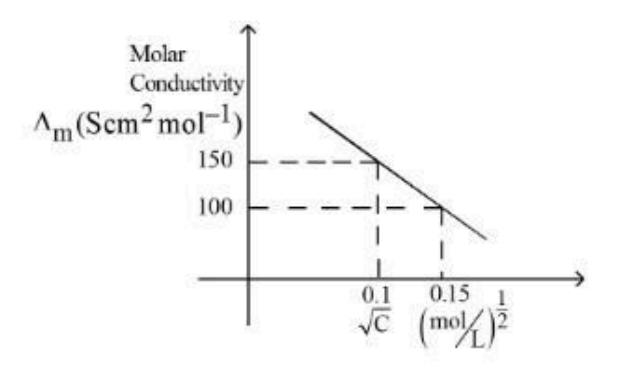
Given below is the plot of the molar conductivity vs c\sqrt{c} concentration for KCl in aqueous solution. If, for the higher concentration of KCl solution, the resistance of the conductivity cell is 100Ω100 \, \Omega, then the resistance of the same cell with the dilute solution is 'x' Ω\Omega. The value of xx is:

Plot of molar conductivity versus square root of concentration for KCl showing values 150 and 100, with corresponding sqrt(c) values 0.1 and 0.15, and a decreasing straight line.

Answer

Correct answer:150

Step-by-step solution

Standard Method

Given: resistance for the higher concentration solution is 100Ω100 \, \Omega. From the graph, the molar conductivity values are 100100 and 150150 for the concentrated and dilute solutions respectively.

Find: the resistance xx of the same cell for the dilute solution.

For the same conductivity cell, the cell constant remains unchanged. Using

Λm=κ×1000C\Lambda_m = \frac{\kappa \times 1000}{C}

and

κ=1R×cell constant\kappa = \frac{1}{R} \times \text{cell constant}

we use the values shown in the extracted working.

For higher concentration:

100=K×10000.0225100 = \frac{K \times 1000}{0.0225}

So,

K=0.022510K = \frac{0.0225}{10}

Also,

K=1R×AK = \frac{1}{R} \times \frac{\ell}{A}

With R=100ΩR = 100 \, \Omega,

A=0.022510×100=0.225\frac{\ell}{A} = \frac{0.0225}{10} \times 100 = 0.225

For lower concentration:

150=K×10000.01150 = \frac{K \times 1000}{0.01}

So,

K=0.15100K = \frac{0.15}{100}

Again,

K=1R×AK = \frac{1}{R} \times \frac{\ell}{A}

Hence,

0.15100=1R×0.225\frac{0.15}{100} = \frac{1}{R} \times 0.225

Therefore,

R=22.50.15=225015=150ΩR = \frac{22.5}{0.15} = \frac{2250}{15} = 150 \, \Omega

So, the value of xx is 150150.

Graph Ratio Method

Given: the same conductivity cell is used, and the resistance at higher concentration is 100Ω100 \, \Omega.

Find: the resistance for the dilute solution.

From the graph:

  • at higher concentration, molar conductivity is 100100
  • at lower concentration, molar conductivity is 150150

For the same cell, conductivity is inversely proportional to resistance, and the graphical comparison used in the provided solution gives a ratio of 1.51.5 between dilute and concentrated cases.

Thus,

RdiluteRconcentrated=150100=1.5\frac{R_{\text{dilute}}}{R_{\text{concentrated}}} = \frac{150}{100} = 1.5

So,

Rdilute=1.5×100=150ΩR_{\text{dilute}} = 1.5 \times 100 = 150 \, \Omega

Therefore, x=150x = 150.

Common mistakes

  • Using molar conductivity and resistance as directly proportional. This is wrong because for a fixed cell, higher conductivity corresponds to lower resistance through κ=1R×cell constant\kappa = \frac{1}{R} \times \text{cell constant}. First relate conductivity and resistance correctly, then compute RR.

  • Reading the graph incorrectly by interchanging the concentrated and dilute points. This is wrong because the higher concentration corresponds to the larger value of c\sqrt{c}, while the dilute solution has the smaller value of c\sqrt{c}. Identify the two graph points before substituting.

  • Ignoring that the same conductivity cell is used in both cases. This is wrong because the cell constant remains unchanged and must be treated as common in the comparison. Use the same cell constant for both solutions.

Practice more Electrolytic Conductance & Kohlrausch's Law questions

Get unlimited AI-adaptive practice, mastery tracking, and an AI tutor that explains every step — free to start.

Related questions