NVAEasyJEE 2026Dual Nature of Matter & de Broglie Relation

JEE Chemistry 2026 Question with Solution

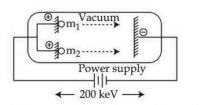
Two positively charged particles m1m_1 and m2m_2 have been accelerated across the same potential difference of 200keV200 \, \text{keV}. Given mass of m1=1amum_1 = 1 \, \text{amu} and m2=4amum_2 = 4 \, \text{amu}. The de Broglie wavelength of m1m_1 will be xx times that of m2m_2. The value of xx is _____ (nearest integer).

Two positively charged particles m1 and m2 move in vacuum between plates, connected to a power supply of 200 keV.

Answer

Correct answer:2

Step-by-step solution

Standard Method

Given: Both positively charged particles are accelerated through the same potential difference of 200keV200 \, \text{keV}. Their masses are m1=1amum_1 = 1 \, \text{amu} and m2=4amum_2 = 4 \, \text{amu}.

Find: The value of xx such that the de Broglie wavelength of m1m_1 is xx times that of m2m_2.

Concept: De Broglie wavelength is

λ=hp=h2mE\lambda = \frac{h}{p} = \frac{h}{\sqrt{2mE}}

where the kinetic energy gained is E=qVE = qV.

Since both particles are accelerated through the same potential difference, they gain the same kinetic energy. Therefore,

λ1m\lambda \propto \frac{1}{\sqrt{m}}

So,

λ1λ2=m2m1\frac{\lambda_1}{\lambda_2} = \sqrt{\frac{m_2}{m_1}}

Substituting the given values,

λ1λ2=41=2\frac{\lambda_1}{\lambda_2} = \sqrt{\frac{4}{1}} = 2

Hence, x=2x = 2.

Therefore, the required value is 22.

Mass Dependence of de Broglie Wavelength

Given: Same accelerating potential for both particles.

Find: The ratio λ1/λ2\lambda_1/\lambda_2.

For a particle accelerated through a potential difference, the kinetic energy is the same here because the solution states both particles gain the same kinetic energy.

Using

λ=h2mE\lambda = \frac{h}{\sqrt{2mE}}

with hh and EE constant for both particles, only mass changes. Thus the wavelength varies inversely as the square root of mass.

So the lighter particle has the larger de Broglie wavelength:

λ1m\lambda \propto \frac{1}{\sqrt{m}}

and therefore

λ1λ2=m2m1=41=2\frac{\lambda_1}{\lambda_2} = \sqrt{\frac{m_2}{m_1}} = \sqrt{\frac{4}{1}} = 2

Therefore, the de Broglie wavelength of m1m_1 is 22 times that of m2m_2.

Common mistakes

  • Assuming the wavelength is inversely proportional to mass instead of inversely proportional to the square root of mass is incorrect. The correct relation is λ1/m\lambda \propto 1/\sqrt{m} when kinetic energy is the same.

  • Using λ1/λ2=m1/m2\lambda_1/\lambda_2 = \sqrt{m_1/m_2} reverses the ratio. Since λ1/m\lambda \propto 1/\sqrt{m}, the correct ratio is λ1/λ2=m2/m1\lambda_1/\lambda_2 = \sqrt{m_2/m_1}.

  • Treating the value 200keV200 \, \text{keV} as needing explicit substitution is unnecessary here because it cancels in the ratio. Focus on the mass dependence after noting both particles have the same kinetic energy.

Practice more Dual Nature of Matter & de Broglie Relation questions

Get unlimited AI-adaptive practice, mastery tracking, and an AI tutor that explains every step — free to start.

Related questions