
Consider the following reactions:
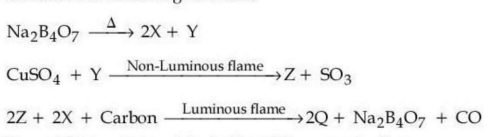
The oxidation states of Cu in Z and Q, respectively are:
- A
and
- B
and
- C
and
- D
and
Consider the following reactions:
The oxidation states of Cu in Z and Q, respectively are:
and
and
and
and
Correct answer:A
Standard Method
Given: The reaction sequence is
Find: The oxidation states of Cu in Z and Q.
From the decomposition of borax:
Now use the second reaction:
In , oxygen is , so copper must be .
In the luminous flame step:
The solution identifies the final copper product as in the luminous flame. In , oxygen is , so the two copper atoms together contribute . Hence each copper atom has oxidation state .
Therefore, the oxidation states of Cu in Z and Q, respectively, are and . The correct option is A.
Oxidation State Tracking
Given: Track the copper species formed in the second and third reactions. Find: Oxidation states of copper in Z and Q.
So, .
Thus .
So, copper has oxidation states in Z and in Q. Hence the correct option is A.
Mistake: Assuming is metallic because reduction occurs in the last step. Why it is wrong: the extracted solution explicitly states that the luminous flame product is , not elemental copper. What to do instead: identify the product named in the solution first, then calculate its oxidation state.
Mistake: Taking the oxidation state of copper in as by copying the value from . Why it is wrong: oxidation state depends on the compound, not only the element. What to do instead: write the charge-balance equation separately for each compound.
Mistake: Not identifying correctly from the second reaction. Why it is wrong: if is misread, the oxidation state question becomes incorrect from the start. What to do instead: first map , , , and from the reaction sequence, then evaluate oxidation states.
Get unlimited AI-adaptive practice, mastery tracking, and an AI tutor that explains every step — free to start.