MCQEasyJEE 2026Orbitals & Shapes

JEE Chemistry 2026 Question with Solution

The figures below show:
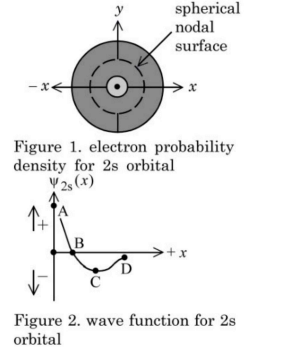
Figure 1 shows electron probability density for 2s orbital with a spherical nodal surface, and Figure 2 shows wave function for 2s orbital versus x with labeled points A, B, C, and D.

Which of the following points in Figure 2 most accurately represents the nodal surface shown in Figure 1?

  • A

    C

  • B

    D

  • C

    B

  • D

    A

Answer

Correct answer:C

Step-by-step solution

Standard Method

Given: Figure 1 shows the 2s2s orbital with a spherical nodal surface. Figure 2 shows the wave function ψ2s(x)\psi_{2s}(x) with labeled points AA, BB, CC, DD.

Find: Which point in Figure 2 represents the nodal surface shown in Figure 1.

Concept: A node is a region where the wave function becomes exactly zero. For hydrogen-like orbitals, the number of radial nodes is

nl1n-l-1

For the 2s2s orbital,

n=2,l=0n=2,\quad l=0

So,

201=12-0-1=1

Thus, the 2s2s orbital has one spherical nodal surface.

Electron probability density is proportional to ψ2|\psi|^2, but the nodal surface is identified by

ψ=0\psi=0

not merely by a low probability.

From Figure 2:

  • Point AA: ψ\psi is positive and maximum.
  • Point BB: ψ=0\psi=0.
  • Point CC: ψ\psi is negative and minimum.
  • Point DD: ψ\psi is negative but non-zero.

Therefore, the nodal surface corresponds to the zero-crossing of the wave function, which is point B.

The correct option is C.

Wave Function Interpretation

Given: The question compares a spherical nodal surface in Figure 1 with the graph of ψ2s(x)\psi_{2s}(x) in Figure 2.

Find: The point on the graph where the nodal surface is represented.

A spherical nodal surface in the 2s2s orbital means that at a particular radius,

ψ2s(r)=0\psi_{2s}(r)=0

When this same behavior is shown along a single axis, the node appears where the plotted wave function crosses the xx-axis.

In Figure 2, only point BB lies on the axis where

ψ2s=0\psi_{2s}=0

Hence, the spherical nodal surface in Figure 1 corresponds to point B in Figure 2.

Therefore, the correct option is C.

Common mistakes

  • Choosing the point where probability is minimum instead of where the wave function is zero. A node is defined by ψ=0\psi=0, not by a small value of ψ2|\psi|^2. Always identify the zero-crossing of the wave function.

  • Confusing point C with the node because it is the lowest point on the graph. A minimum negative value is still non-zero, so it is not a node. Check whether the graph actually crosses the axis.

  • Using the orbital picture incorrectly and not connecting it to the graph. The spherical nodal surface in the 2s2s orbital corresponds to a specific radius where ψ2s(r)=0\psi_{2s}(r)=0. On a one-dimensional plot, this appears as the axis-crossing point.

Practice more Orbitals & Shapes questions

Get unlimited AI-adaptive practice, mastery tracking, and an AI tutor that explains every step — free to start.

Related questions