
Suppose there is a uniform circular disc of mass kg and radius m shown in figure. The shaded regions are cut out from the disc. The moment of inertia of the remainder about the axis of the disc is given by . The value of is _____.
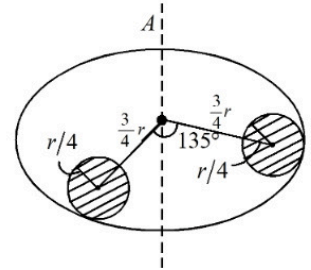
Suppose there is a uniform circular disc of mass kg and radius m shown in figure. The shaded regions are cut out from the disc. The moment of inertia of the remainder about the axis of the disc is given by . The value of is _____.
Correct answer:109
Standard Method
Given: A uniform circular disc has mass and radius . Two circular regions are cut out.
Find: The value of in
Use additivity of moment of inertia and treat each hole as removed mass.
Area mass density of the original disc is
The cut-out regions are two circles of radius
whose centers are at distance
from axis .
Mass of one cut-out circle is
Moment of inertia of one cut-out about its own center is
Using the parallel axis theorem, moment of inertia of one cut-out about the main axis is
Total moment of inertia removed for two holes is
Moment of inertia of the original full disc about axis is
Therefore, moment of inertia of the remainder is
Hence,
So the required numerical value is 109.
The solution lists Correct Answer: 236, but the worked solution clearly gives
Therefore, the answer derived from the solution working is 109.
Treating the holes as extra masses instead of removed masses is incorrect. The moment of inertia of the cut-out regions must be subtracted from that of the full disc. Use .
Using the formula directly for each small cut-out about axis is wrong because that formula is about the cut-out's own center. First find , then apply the parallel axis theorem.
Forgetting that there are two identical holes leads to underestimating the removed moment of inertia. After finding the contribution of one hole, multiply by .
Get unlimited AI-adaptive practice, mastery tracking, and an AI tutor that explains every step — free to start.