
MCQMediumJEE 2026Measures of Central Tendency

JEE Mathematics 2026 Question with Solution

If the mean and the variance of the data
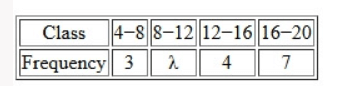
A frequency distribution table with class intervals $$4\text{–}8$$, $$8\text{–}12$$, $$12\text{–}16$$, $$16\text{–}20$$ and corresponding frequencies $$3$$, $$\lambda$$, $$4$$, $$7$$.

are μ\mu and 1919 respectively, then the value of λ+μ\lambda + \mu is

  • A

    2121

  • B

    1818

  • C

    1919

  • D

    2020

Answer

Correct answer:C

Step-by-step solution

Standard Method

Given: The class mid-points are 6,10,14,186, 10, 14, 18 with frequencies 3,λ,4,73, \lambda, 4, 7. The variance is 1919.

Find: λ+μ\lambda + \mu.

Using step-deviation, take assumed mean A=14A = 14 and class width h=4h = 4. Define

ui=xi144u_i = \frac{x_i - 14}{4}

So the values are 2,1,0,1-2, -1, 0, 1.

The total frequency is

N=3+λ+4+7=14+λN = 3 + \lambda + 4 + 7 = 14 + \lambda

Now

uˉ=fiuiN=3(2)+λ(1)+4(0)+7(1)14+λ=1λ14+λ\bar{u} = \frac{\sum f_i u_i}{N} = \frac{3(-2) + \lambda(-1) + 4(0) + 7(1)}{14+\lambda} = \frac{1-\lambda}{14+\lambda}

Also,

fiui2=3(4)+λ(1)+4(0)+7(1)=19+λ\sum f_i u_i^2 = 3(4) + \lambda(1) + 4(0) + 7(1) = 19 + \lambda

Using variance under scale change,

σx2=h2σu2=16[fiui2N(uˉ)2]=19\sigma_x^2 = h^2 \sigma_u^2 = 16 \left[ \frac{\sum f_i u_i^2}{N} - (\bar{u})^2 \right] = 19

Hence,

19=16[19+λ14+λ(1λ14+λ)2]19 = 16 \left[ \frac{19+\lambda}{14+\lambda} - \left(\frac{1-\lambda}{14+\lambda}\right)^2 \right]

So,

1916=(19+λ)(14+λ)(1λ)2(14+λ)2\frac{19}{16} = \frac{(19+\lambda)(14+\lambda) - (1-\lambda)^2}{(14+\lambda)^2}

That gives

19(14+λ)2=16[(266+33λ+λ2)(12λ+λ2)]19(14+\lambda)^2 = 16 \left[ (266 + 33\lambda + \lambda^2) - (1 - 2\lambda + \lambda^2) \right] 19(196+28λ+λ2)=16(265+35λ)19(196 + 28\lambda + \lambda^2) = 16(265 + 35\lambda) 3724+532λ+19λ2=4240+560λ3724 + 532\lambda + 19\lambda^2 = 4240 + 560\lambda 19λ228λ516=019\lambda^2 - 28\lambda - 516 = 0

Solving,

λ=28±20038\lambda = \frac{28 \pm 200}{38}

Since frequency must be positive,

λ=6\lambda = 6

Now,

uˉ=1620=14\bar{u} = \frac{1-6}{20} = -\frac{1}{4}

Therefore,

μ=14+4(14)=13\mu = 14 + 4\left(-\frac{1}{4}\right) = 13

So,

λ+μ=6+13=19\lambda + \mu = 6 + 13 = 19

Therefore, the correct option is C.

Variance using step-deviation

Given: A grouped frequency distribution with unknown frequency λ\lambda and mean μ\mu.

Find: λ+μ\lambda + \mu.

The key idea is that variance is unaffected by change of origin but changes by the square of the scale factor. With

u=x144u = \frac{x-14}{4}

we use

Var(x)=16Var(u)\operatorname{Var}(x) = 16\operatorname{Var}(u)

The frequency table in terms of uu becomes:

  • for x=6x = 6, u=2u = -2 with frequency 33
  • for x=10x = 10, u=1u = -1 with frequency λ\lambda
  • for x=14x = 14, u=0u = 0 with frequency 44
  • for x=18x = 18, u=1u = 1 with frequency 77

Now compute the required sums:

fiui=3(2)+λ(1)+4(0)+7(1)=1λ\sum f_i u_i = 3(-2) + \lambda(-1) + 4(0) + 7(1) = 1 - \lambda N=14+λN = 14 + \lambda uˉ=1λ14+λ\bar{u} = \frac{1-\lambda}{14+\lambda}

Also,

fiui2=3(4)+λ(1)+4(0)+7(1)=19+λ\sum f_i u_i^2 = 3(4) + \lambda(1) + 4(0) + 7(1) = 19 + \lambda

So,

σu2=19+λ14+λ(1λ14+λ)2\sigma_u^2 = \frac{19+\lambda}{14+\lambda} - \left(\frac{1-\lambda}{14+\lambda}\right)^2

Since σx2=19\sigma_x^2 = 19,

19=16σu219 = 16\sigma_u^2

Substituting,

19=16[19+λ14+λ(1λ14+λ)2]19 = 16 \left[ \frac{19+\lambda}{14+\lambda} - \left(\frac{1-\lambda}{14+\lambda}\right)^2 \right]

After simplification,

19λ228λ516=019\lambda^2 - 28\lambda - 516 = 0

This gives

λ=6\lambda = 6

Now the mean is recovered from

μ=A+huˉ=14+4(1620)=13\mu = A + h\bar{u} = 14 + 4\left(\frac{1-6}{20}\right) = 13

Hence,

λ+μ=19\lambda + \mu = 19

Thus, the correct option is C.

Common mistakes

  • Using class limits directly in place of class mid-points is incorrect because the mean and variance of grouped data are computed from the mid-points. First take the mid-points 6,10,14,186, 10, 14, 18.

  • Applying the variance formula without accounting for scale is wrong. If u=x144u = \frac{x-14}{4}, then Var(x)=16Var(u)\operatorname{Var}(x) = 16\operatorname{Var}(u), not just Var(u)\operatorname{Var}(u).

  • Rejecting the condition on frequency leads to an invalid value of λ\lambda. After solving the quadratic, keep only the positive value because frequency cannot be negative.

Practice more Measures of Central Tendency questions

Get unlimited AI-adaptive practice, mastery tracking, and an AI tutor that explains every step — free to start.

Related questions