
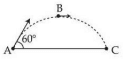
An object is projected with kinetic energy from point A at an angle with the horizontal. The ratio of the difference in kinetic energies at points B and C to that at point A (see figure), in the absence of air friction is :
- A
- B
- C
- D
An object is projected with kinetic energy from point A at an angle with the horizontal. The ratio of the difference in kinetic energies at points B and C to that at point A (see figure), in the absence of air friction is :
Correct answer:C
Standard Method
Given: The object is projected from point A with initial kinetic energy at angle . Point B is the highest point of the projectile and point C is the landing point.
Find: The ratio of the difference in kinetic energies at points B and C to that at point A.
In projectile motion, the horizontal component of velocity remains constant, while the vertical component becomes zero at the highest point.
At point A,
The horizontal velocity is
At the highest point B, the vertical component is zero, so kinetic energy is only due to the horizontal component:
At point C, the projectile returns to the same horizontal level as A, so its speed is again and hence
Therefore, the difference in kinetic energies at points B and C is
Now compare this with the kinetic energy at point A:
Therefore, the required ratio is . The correct option is C.
Using kinetic energy at maximum height
Given: Initial kinetic energy is and launch angle is .
Find: Ratio of the loss in kinetic energy from the initial point to the highest point, compared with the initial kinetic energy.
At maximum height of a projectile, the kinetic energy is not zero. It becomes
Here, , so
Initial kinetic energy at A is
Hence, the difference is
Now ratio with kinetic energy at A:
So the ratio is .
The solution states points B and C, but the working clearly evaluates the kinetic energy change between the initial point and the highest point. That gives option C.
Assuming the kinetic energy at the highest point is zero. This is wrong because the horizontal component of velocity remains constant in projectile motion. Use only the vertical component as zero and keep .
Treating point C as the highest point instead of the landing point or misreading the figure labels. This leads to comparing the wrong points. First identify from the trajectory that B is the topmost point and use that point for minimum kinetic energy.
Using instead of . Kinetic energy depends on the square of speed, so when velocity becomes , the kinetic energy becomes .
Get unlimited AI-adaptive practice, mastery tracking, and an AI tutor that explains every step — free to start.