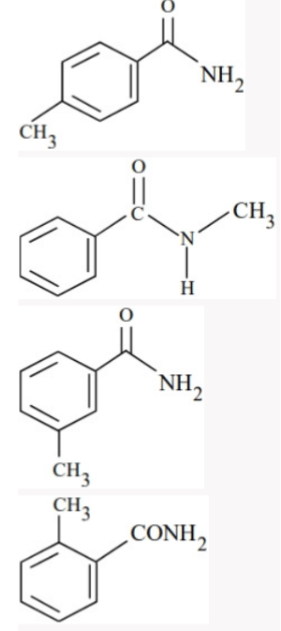
Given: A has molecular formula C8H9ON and gives B with aqueous Br2/HO−. Compound B undergoes diazotization with aqueous NaNO2/HCl at 0–5∘C to form C, which with CuCN/NaCN gives D. Hydrolysis of D gives E, and E is also formed by hydrolysis of A. Oxidation of E with acidified KMnO4 gives F having two different types of hydrogen atoms.
Find: The structure of A.
Aqueous Br2/HO− indicates the Hofmann bromamide reaction, so A must be an amide and B must be an amine with one fewer carbon atom.
The molecular formula C8H9ON is consistent with a methyl-substituted benzamide.
Diazotization of aromatic amine B with aqueous NaNO2/HCl at 0–5∘C forms diazonium salt C. Reaction with CuCN/NaCN replaces the diazonium group by −CN to give nitrile D. Hydrolysis of nitrile D gives carboxylic acid E.
Since hydrolysis of A also gives the same acid E, A must be the corresponding benzamide derivative.
Oxidation of E with acidified KMnO4 converts the methyl group into another carboxylic acid group. The product F has two different types of hydrogen atoms, which matches a meta-substituted benzenedicarboxylic acid.
Therefore, among the given options, only m-methyl benzamide satisfies all the conditions.
The correct option is A.