
The correct order of the rate of reaction of the following reactants with nucleophile by mechanism is:
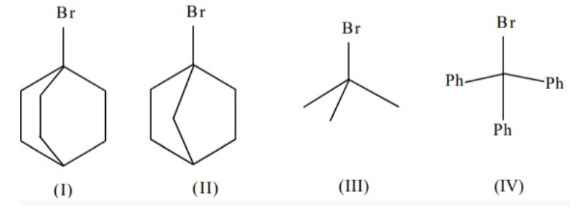
(Given: Structures and are rigid)
- A
- B
- C
- D
The correct order of the rate of reaction of the following reactants with nucleophile by mechanism is:
(Given: Structures and are rigid)
Correct answer:C
Standard Method
Given: Four reactants are compared for rate of reaction with a nucleophile by mechanism.
Find: The correct increasing order of rate.
In an reaction, the rate depends on the stability of the carbocation formed after the leaving group departs. Resonance stabilization is more effective than hyperconjugation for stabilizing the carbocation.
From the given explanation:
Therefore, the increasing order of carbocation stability, and hence the increasing order of rate, is
Thus, the correct option is C.
Assuming that a more substituted carbon always reacts faster in . That is incomplete here because rigidity and strain in bicyclic systems can strongly destabilize the carbocation. First examine whether the carbocation can actually form comfortably.
Ignoring resonance stabilization in . A triphenylmethyl carbocation is far more stable than an ordinary tertiary carbocation because the positive charge is delocalized over three phenyl rings. Do not compare and only by degree of substitution.
Treating structures and as equivalent just because both are rigid. The solution states that is more strained and gives the least stable carbocation, while is slightly less strained. Compare relative strain, not only the word rigid.
Get unlimited AI-adaptive practice, mastery tracking, and an AI tutor that explains every step — free to start.