
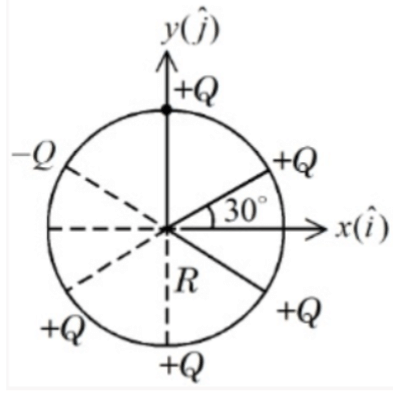
Six point charges are kept apart from each other on the circumference of a circle of radius as shown in figure. The net electric field at the center of the circle is ____. ( is permittivity of free space)
- A
- B
- C
- D
Six point charges are kept apart from each other on the circumference of a circle of radius as shown in figure. The net electric field at the center of the circle is ____. ( is permittivity of free space)
Correct answer:B
Standard Method
Given: Six point charges are placed on the circumference of a circle of radius at angular separation .
Find: The net electric field at the center.
Each charge is placed at a distance from the center. The magnitude of electric field due to a charge at the center is
Step 1: Analyze symmetry of charge distribution.
From the figure, the charges are placed at angular separations of . Due to symmetry, electric field vectors due to opposite charges partially cancel each other. Hence, we resolve the electric field vectors along the -axis and -axis.
Step 2: Resolve horizontal components.
Considering the directions of electric field due to each charge, the net horizontal component is proportional to
Step 3: Resolve vertical components.
Similarly, the net vertical component is proportional to
Step 4: Write the resultant electric field vector.
Combining both components,
Therefore, the correct option is B.
Component-Based Interpretation
Given: The electric field at the center is to be obtained by vector addition of fields due to all six charges.
Find: The resultant in unit-vector form.
Use the fact that each contribution has the same magnitude
but different direction depending on the position and sign of the charge.
The solution indicates that after resolving all fields:
So the net field is
which is equivalently written as
Hence, the final answer is , so the correct option is B.
Students often add only magnitudes and ignore vector directions. This is wrong because electric field is a vector quantity. Resolve each field into and components before summing.
A common error is using the same direction for fields due to both positive and negative charges. This is incorrect because the field at the center is directed away from a positive charge and toward a negative charge. Assign directions carefully from the figure.
Some students assume complete cancellation because the charges are equally spaced. This is wrong because the signs of the charges are not all identical, so symmetry is only partial. Check the sign pattern before applying cancellation arguments.
Get unlimited AI-adaptive practice, mastery tracking, and an AI tutor that explains every step — free to start.