
The correct order of reactivity of the following benzyl halides towards reaction with KCN is :
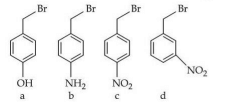
- A
b a c d
- B
a b c d
- C
a b d c
- D
b a d c
The correct order of reactivity of the following benzyl halides towards reaction with KCN is :
b a c d
a b c d
a b d c
b a d c
Correct answer:D
Standard Method
Given: The reactivity order of substituted benzyl halides towards reaction with KCN is to be determined.
Find: The correct sequence among a, b, c, d.
For benzylic substitution with KCN in a polar aprotic medium, the reaction generally proceeds through an pathway, but the benzylic transition state is influenced by substituents through resonance and inductive effects.
The solution states that the developing positive character in the transition state is stabilized by electron-donating groups.
Therefore, the reactivity order is b a d c.
The correct option is D.
Explanation from Substituent Effects
Given: Four benzyl bromides differ by ring substituents: para hydroxy, para amino, para nitro, and meta nitro.
Find: Which one reacts fastest with KCN, and hence the overall order.
The key idea from the solution is stabilization of the benzylic substitution transition state.
Thus:
Hence the final order is b a d c, so the correct option is D.
Assuming the reaction depends only on the mechanism and ignoring substituent effects is incorrect. In benzylic systems, the transition state is strongly affected by resonance stabilization. Compare how each substituent donates or withdraws electron density before ranking reactivity.
Treating meta nitro and para nitro as equivalent is wrong. The para group exerts a stronger resonance withdrawing effect, while the meta isomer mainly shows the inductive effect. Therefore para nitro decreases reactivity more than meta nitro.
Reversing the order of and is a common error. Both are groups, but is the stronger resonance donor, so the para amino compound reacts faster than the para hydroxy compound.
Get unlimited AI-adaptive practice, mastery tracking, and an AI tutor that explains every step — free to start.