MCQMediumJEE 2026Bernoulli's Theorem

JEE Physics 2026 Question with Solution

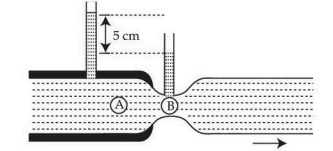
Water flows through a horizontal tube as shown in the figure. The difference in height between the water columns in vertical tubes is 5cm5 \, \text{cm} and the area of cross-sections at A and B are 6cm26 \, \text{cm}^2 and 3cm23 \, \text{cm}^2 respectively. The rate of flow will be _____ cm3/s\text{cm}^3/\text{s}. (take g=10m/s2g = 10 \, \text{m/s}^2).

A horizontal tube narrows at section B and widens again, with vertical water columns at A and B showing a height difference of 5 cm and flow to the right.
  • A

    2006200\sqrt{6}

  • B

    1003100\sqrt{3}

  • C

    200/3200/\sqrt{3}

  • D

    2003200\sqrt{3}

Answer

Correct answer:D

Step-by-step solution

Standard Method

Given: AA=6cm2A_A = 6 \, \text{cm}^2, AB=3cm2A_B = 3 \, \text{cm}^2, height difference h=5cmh = 5 \, \text{cm}, and g=10m/s2=1000cm/s2g = 10 \, \text{m/s}^2 = 1000 \, \text{cm/s}^2.

Find: The volume flow rate QQ.

Use the equation of continuity and Bernoulli's equation for a horizontal tube.

From continuity,

AAvA=ABvB=QA_A v_A = A_B v_B = Q

So,

6vA=3vB6v_A = 3v_B

which gives

vB=2vAv_B = 2v_A

The pressure difference is related to the difference in water column heights by

PAPB=ρghP_A - P_B = \rho g h

For a horizontal tube, Bernoulli's equation gives

PA+12ρvA2=PB+12ρvB2P_A + \frac{1}{2}\rho v_A^2 = P_B + \frac{1}{2}\rho v_B^2

Therefore,

PAPB=12ρ(vB2vA2)P_A - P_B = \frac{1}{2}\rho \left(v_B^2 - v_A^2\right)

So,

ρgh=12ρ(vB2vA2)\rho g h = \frac{1}{2}\rho \left(v_B^2 - v_A^2\right)

Cancelling ρ\rho,

gh=12(vB2vA2)gh = \frac{1}{2}\left(v_B^2 - v_A^2\right)

Substitute vB=2vAv_B = 2v_A:

gh=12((2vA)2vA2)gh = \frac{1}{2}\left((2v_A)^2 - v_A^2\right) gh=12(4vA2vA2)gh = \frac{1}{2}\left(4v_A^2 - v_A^2\right) gh=32vA2gh = \frac{3}{2}v_A^2

Hence,

vA2=2gh3v_A^2 = \frac{2gh}{3} vA=2gh3=2×1000×53=100003=1003cm/sv_A = \sqrt{\frac{2gh}{3}} = \sqrt{\frac{2 \times 1000 \times 5}{3}} = \sqrt{\frac{10000}{3}} = \frac{100}{\sqrt{3}} \, \text{cm/s}

Now calculate flow rate:

Q=AAvAQ = A_A v_A Q=6×1003=6003cm3/sQ = 6 \times \frac{100}{\sqrt{3}} = \frac{600}{\sqrt{3}} \, \text{cm}^3/\text{s}

Rationalizing,

Q=60033=2003cm3/sQ = \frac{600\sqrt{3}}{3} = 200\sqrt{3} \, \text{cm}^3/\text{s}

Therefore, the rate of flow is 2003cm3/s200\sqrt{3} \, \text{cm}^3/\text{s} and the correct option is D.

Using the Venturi Flow Formula

Given: AA=6cm2A_A = 6 \, \text{cm}^2, AB=3cm2A_B = 3 \, \text{cm}^2, h=5cmh = 5 \, \text{cm}, g=1000cm/s2g = 1000 \, \text{cm/s}^2.

Find: The flow rate QQ.

For a venturi meter, the derived relation is

Q=AAAB2ghAA2AB2Q = A_A A_B \sqrt{\frac{2gh}{A_A^2 - A_B^2}}

This works because it combines continuity and Bernoulli's equation into one direct expression.

Substitute the values:

Q=6×32×1000×56232Q = 6 \times 3 \sqrt{\frac{2 \times 1000 \times 5}{6^2 - 3^2}} Q=1810000369=181000027Q = 18 \sqrt{\frac{10000}{36 - 9}} = 18 \sqrt{\frac{10000}{27}} Q=18×10033=6003=2003cm3/sQ = 18 \times \frac{100}{3\sqrt{3}} = \frac{600}{\sqrt{3}} = 200\sqrt{3} \, \text{cm}^3/\text{s}

Therefore, the correct option is D.

Common mistakes

  • Using the height difference directly in SI and the areas in cgs together is wrong because the units become inconsistent. Convert all quantities to one system first; here the solution uses cgs, so g=1000cm/s2g = 1000 \, \text{cm/s}^2.

  • Writing continuity as vA=2vBv_A = 2v_B is wrong. Since AAvA=ABvBA_A v_A = A_B v_B and AA=6A_A = 6 while AB=3A_B = 3, the correct relation is vB=2vAv_B = 2v_A.

  • Applying Bernoulli without using the pressure difference from the water columns is incomplete. The vertical columns give PAPB=ρghP_A - P_B = \rho g h, and that relation must be substituted into Bernoulli's equation.

Practice more Bernoulli's Theorem questions

Get unlimited AI-adaptive practice, mastery tracking, and an AI tutor that explains every step — free to start.

Related questions