NVAMediumJEE 2025Moment of Inertia & Radius of Gyration

JEE Physics 2025 Question with Solution

A, B and C are disc, solid sphere and spherical shell respectively with the same radii and masses. These masses are placed as shown in the figure.
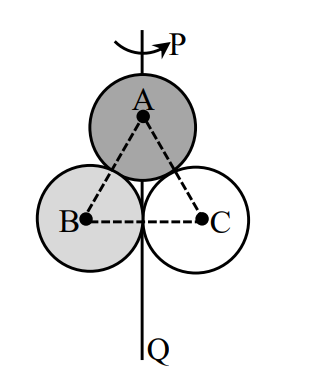
Three equal circular bodies arranged in triangular contact: top disc A, lower left solid sphere B, lower right spherical shell C, with a vertical axis PQ passing through the top body and the midpoint between the two lower bodies.

The moment of inertia of the given system about PQ is x15I\frac{x}{15} I, where II is the moment of inertia of the disc about its diameter. The value of xx is:

Answer

Correct answer:199

Step-by-step solution

Standard Method

Given: Bodies A, B and C are a disc, solid sphere and spherical shell respectively, each of mass MM and radius RR. The axis is PQ. Also, II is the moment of inertia of the disc about its diameter.

Find: The value of xx if the total moment of inertia is x15I\frac{x}{15} I.

For the disc,

I=Idisc=14MR2I = I_{\text{disc}} = \frac{1}{4}MR^2

For the solid sphere about its own centre,

Isphere=25MR2I_{\text{sphere}} = \frac{2}{5}MR^2

Using the parallel axis theorem with distance d=Rd = R,

Isphere, PQ=Isphere+Md2=25MR2+MR2=75MR2I_{\text{sphere, PQ}} = I_{\text{sphere}} + Md^2 = \frac{2}{5}MR^2 + MR^2 = \frac{7}{5}MR^2

For the spherical shell about its own centre,

Ishell=23MR2I_{\text{shell}} = \frac{2}{3}MR^2

Again using the parallel axis theorem with d=Rd = R,

Ishell, PQ=Ishell+Md2=23MR2+MR2=53MR2I_{\text{shell, PQ}} = I_{\text{shell}} + Md^2 = \frac{2}{3}MR^2 + MR^2 = \frac{5}{3}MR^2

Hence, total moment of inertia about PQ is

Itotal=Idisc, PQ+Isphere, PQ+Ishell, PQI_{\text{total}} = I_{\text{disc, PQ}} + I_{\text{sphere, PQ}} + I_{\text{shell, PQ}} Itotal=14MR2+75MR2+53MR2I_{\text{total}} = \frac{1}{4}MR^2 + \frac{7}{5}MR^2 + \frac{5}{3}MR^2

Taking the LCM as 6060,

Itotal=(1560+8460+10060)MR2=19960MR2I_{\text{total}} = \left(\frac{15}{60} + \frac{84}{60} + \frac{100}{60}\right)MR^2 = \frac{199}{60}MR^2

Now given

x15I=19960MR2\frac{x}{15}I = \frac{199}{60}MR^2

Substitute I=14MR2I = \frac{1}{4}MR^2:

x1514MR2=19960MR2\frac{x}{15}\cdot \frac{1}{4}MR^2 = \frac{199}{60}MR^2 x60=19960\frac{x}{60} = \frac{199}{60} x=199x = 199

Therefore, the value of xx is 199199.

Direct Summation Trick

Given: I=14MR2I = \frac{1}{4}MR^2 for the disc about its diameter.

Find: The value of xx in IPQ=x15II_{PQ} = \frac{x}{15}I.

Directly write the three contributions about PQ:

IA=14MR2,IB=75MR2,IC=53MR2I_A = \frac{1}{4}MR^2, \qquad I_B = \frac{7}{5}MR^2, \qquad I_C = \frac{5}{3}MR^2

So,

IPQ=MR2(14+75+53)=19960MR2I_{PQ} = MR^2\left(\frac{1}{4} + \frac{7}{5} + \frac{5}{3}\right) = \frac{199}{60}MR^2

But,

x15I=x1514MR2=x60MR2\frac{x}{15}I = \frac{x}{15}\cdot \frac{1}{4}MR^2 = \frac{x}{60}MR^2

Comparing coefficients of MR2MR^2,

x60=19960\frac{x}{60} = \frac{199}{60} x=199x = 199

This works because every term is proportional to MR2MR^2, so comparing coefficients is enough. Thus, the value of xx is 199199.

Common mistakes

  • Using the moment of inertia of the solid sphere or spherical shell about their centres directly for axis PQ is incorrect, because PQ does not pass through their centres. Use the parallel axis theorem and add Md2Md^2 with d=Rd = R.

  • Taking the distance from the centre of the sphere or shell to axis PQ incorrectly is a common error. From the given arrangement, the required perpendicular distance is RR, not 2R2R or 00.

  • Confusing the standard formulas for different bodies leads to wrong results. The disc about diameter is 14MR2\frac{1}{4}MR^2, the solid sphere about centre is 25MR2\frac{2}{5}MR^2, and the spherical shell about centre is 23MR2\frac{2}{3}MR^2. Use each formula for the correct body only.

Practice more Moment of Inertia & Radius of Gyration questions

Get unlimited AI-adaptive practice, mastery tracking, and an AI tutor that explains every step — free to start.

Related questions