
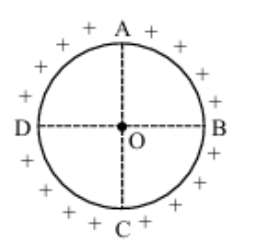
A metallic ring is uniformly charged as shown in the figure. AC and BD are two mutually perpendicular diameters. Electric field due to arc AB to O is magnitude. What would be the magnitude of electric field at O due to arc ABC?
- A
- B
- C
- D
Zero
A metallic ring is uniformly charged as shown in the figure. AC and BD are two mutually perpendicular diameters. Electric field due to arc AB to O is magnitude. What would be the magnitude of electric field at O due to arc ABC?
Zero
Correct answer:B
Standard Method
Given: The electric field at due to arc is . The ring is uniformly charged.
Find: The magnitude of electric field at due to arc .
Arc is made of two equal quarter-arcs, and . Since the charge distribution is uniform, arc also produces an electric field of magnitude at .
The field due to arc acts along the bisector of that arc, and the field due to arc acts along the bisector of arc . These two directions are perpendicular to each other.
So, the net field is the vector sum of two perpendicular vectors of equal magnitude :
Therefore, the magnitude of the electric field at due to arc is . The correct option is B.
Symmetry Shortcut
Given: Arc gives field at .
Find: Field due to arc .
By symmetry, arc contributes the same magnitude . The two resultants are at right angles because the two quarter-arcs are adjacent and subtend equal sectors.
Hence, treat them as perpendicular vectors:
Therefore, the correct option is B.
Assuming the fields due to arcs and cancel each other. This is incorrect because the two field vectors are perpendicular, not opposite. Add them vectorially instead of subtracting.
Treating arc as a semicircle and directly using a semicircle formula. The question gives the field due to one quarter-arc as , so the required result should be obtained by combining the two quarter-arc contributions.
Adding magnitudes algebraically to get . That would be valid only if both electric field vectors were along the same line. Here they are mutually perpendicular, so use the Pythagorean theorem.
Get unlimited AI-adaptive practice, mastery tracking, and an AI tutor that explains every step — free to start.