
MCQMediumJEE 2025Simple Applications

JEE Mathematics 2025 Question with Solution

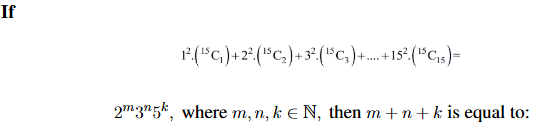
Expression asking: If 1 squared times 15C1 plus 2 squared times 15C2 plus 3 squared times 15C3 up to 15 squared times 15C15 equals 2 raised to m times 3 raised to n times 5 raised to k, find m plus n plus k.
  • A

    1919

  • B

    2121

  • C

    1818

  • D

    2020

Answer

Correct answer:A

Step-by-step solution

Standard Method

Given:

r=115r2(15r)=2m3n5k\sum_{r=1}^{15} r^2 \binom{15}{r} = 2^m 3^n 5^k

Find: m+n+km+n+k.

Use the identity

r2(15r)=15r(14r1)r^2 \binom{15}{r} = 15r \binom{14}{r-1}

and then split r=(r1)+1r = (r-1)+1. Equivalently,

r2(15r)=15(r1)(14r1)+15(14r1)r^2 \binom{15}{r} = 15(r-1)\binom{14}{r-1} + 15\binom{14}{r-1}

which gives

r2(15r)=1514(13r2)+15(14r1).r^2 \binom{15}{r} = 15\cdot 14 \binom{13}{r-2} + 15\binom{14}{r-1}.

Therefore,

r=115r2(15r)=1514r=115(13r2)+15r=115(14r1).\sum_{r=1}^{15} r^2 \binom{15}{r} = 15\cdot 14 \sum_{r=1}^{15} \binom{13}{r-2} + 15 \sum_{r=1}^{15} \binom{14}{r-1}.

Now use the binomial sums

r=115(13r2)=213,r=115(14r1)=214.\sum_{r=1}^{15} \binom{13}{r-2} = 2^{13}, \qquad \sum_{r=1}^{15} \binom{14}{r-1} = 2^{14}.

So,

r=115r2(15r)=1514213+15214.\sum_{r=1}^{15} r^2 \binom{15}{r} = 15\cdot 14\cdot 2^{13} + 15\cdot 2^{14}.

Factoring,

=15213(14+2)=1521316=15217.= 15\cdot 2^{13}(14+2) = 15\cdot 2^{13}\cdot 16 = 15\cdot 2^{17}.

Now,

15217=3151217.15\cdot 2^{17} = 3^1 \cdot 5^1 \cdot 2^{17}.

Hence,

m=17,  n=1,  k=1.m=17, \; n=1, \; k=1.

Therefore, m+n+k=17+1+1=19m+n+k = 17+1+1 = 19. The correct option is A.

Using standard binomial identities

From the solution, the series is interpreted as

12(151)+22(152)+32(153)++152(1515).1^2\binom{15}{1}+2^2\binom{15}{2}+3^2\binom{15}{3}+\cdots+15^2\binom{15}{15}.

Write

r2=r(r1)+r.r^2 = r(r-1)+r.

Then

r=115r2(15r)=r=115r(r1)(15r)+r=115r(15r).\sum_{r=1}^{15} r^2 \binom{15}{r} = \sum_{r=1}^{15} r(r-1)\binom{15}{r} + \sum_{r=1}^{15} r\binom{15}{r}.

Now apply the identities

r(r1)(15r)=1514(13r2),r(r-1)\binom{15}{r} = 15\cdot 14\binom{13}{r-2},

and

r(15r)=15(14r1).r\binom{15}{r} = 15\binom{14}{r-1}.

So,

r=115r2(15r)=1514r=115(13r2)+15r=115(14r1).\sum_{r=1}^{15} r^2 \binom{15}{r} = 15\cdot 14 \sum_{r=1}^{15}\binom{13}{r-2} + 15\sum_{r=1}^{15}\binom{14}{r-1}.

Each sum is a complete binomial sum after index shift:

r=115(13r2)=t=013(13t)=213,\sum_{r=1}^{15}\binom{13}{r-2} = \sum_{t=0}^{13}\binom{13}{t} = 2^{13}, r=115(14r1)=u=014(14u)=214.\sum_{r=1}^{15}\binom{14}{r-1} = \sum_{u=0}^{14}\binom{14}{u} = 2^{14}.

Hence,

r=115r2(15r)=1514213+15214=15217.\sum_{r=1}^{15} r^2 \binom{15}{r} = 15\cdot 14\cdot 2^{13} + 15\cdot 2^{14} = 15\cdot 2^{17}.

Prime factorizing,

15217=2173151.15\cdot 2^{17} = 2^{17}3^15^1.

Thus m=17m=17, n=1n=1, k=1k=1, so m+n+k=19m+n+k=19.

Common mistakes

  • Using r2(nr)\sum r^2\binom{n}{r} directly without first rewriting r2r^2 as r(r1)+rr(r-1)+r. This is wrong because the standard binomial identities apply to r(nr)r\binom{n}{r} and r(r1)(nr)r(r-1)\binom{n}{r} separately. Rewrite the term before summing.

  • Missing the second term after decomposition and taking only 151421315\cdot 14\cdot 2^{13}. This is wrong because r2=r(r1)+rr^2 = r(r-1)+r has two contributions. Add both sums before factorization.

  • Making an index-shift error in (13r2)\sum \binom{13}{r-2} or (14r1)\sum \binom{14}{r-1}. This is wrong because the shifted limits produce complete binomial sums. Convert carefully to t=013(13t)\sum_{t=0}^{13}\binom{13}{t} and u=014(14u)\sum_{u=0}^{14}\binom{14}{u}.

Practice more Simple Applications questions

Get unlimited AI-adaptive practice, mastery tracking, and an AI tutor that explains every step — free to start.

Related questions