NVAEasyJEE 2025Capacitors & Dielectrics

JEE Physics 2025 Question with Solution

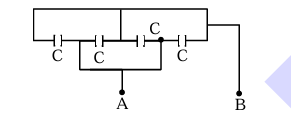
Four capacitors each of capacitance 16μF16\,\mu F are connected as shown in the figure. The capacitance between points A and B is: _____ (in μF\mu F).

Circuit diagram showing four identical capacitors in a wire network between terminals A and B, with one capacitor on the left vertical branch, two on the lower horizontal branch, and one on the right vertical branch.

Answer

Correct answer:64

Step-by-step solution

Standard Method

Given: Each capacitor has capacitance C=16μFC = 16\,\mu F.

Find: The equivalent capacitance CABC_{AB} between points AA and BB.

Concept Used: If all capacitors are connected across the same two nodes, they are in parallel, and their equivalent capacitance is the sum of individual capacitances.

Ceq=CiC_{\text{eq}} = \sum C_i

Shorted or directly connected points are at the same potential and can be treated as a single node.

Step 1: The top rail is a single conductor and finally goes down to point BB. Hence every point on the top rail is at the potential of BB.

Step 2: The lower rectangular wire connects the two midpoints and drops to AA. Therefore the entire lower rectangular path is at the potential of AA.

Step 3: With these node identifications, each of the four capacitors is connected directly between the same two nodes AA and BB. Therefore, all four capacitors are in parallel.

Step 4: Add the capacitances in parallel.

CAB=C+C+C+C=4C=4×16μF=64μFC_{AB} = C + C + C + C = 4C = 4 \times 16\,\mu F = 64\,\mu F

Therefore, the equivalent capacitance between AA and BB is 64μF64\,\mu F.

Direct Node Inspection

Given: Four identical capacitors, each of capacitance 16μF16\,\mu F.

Find: Equivalent capacitance between AA and BB.

Instead of reducing the circuit branch by branch, inspect the nodes. The upper conductor is one common node ending at BB, and the lower conductor is one common node ending at AA. Since every capacitor has one plate on the upper node and the other plate on the lower node, all capacitors are in parallel.

CAB=4C=4×16μF=64μFC_{AB} = 4C = 4 \times 16\,\mu F = 64\,\mu F

Therefore, the correct numerical answer is 64.

Common mistakes

  • Mistake: Treating the arrangement as a series combination by looking only at the drawing shape. Why it is wrong: series connection requires capacitors to share intermediate isolated nodes, which is not the case here. What to do instead: first identify equipotential points connected by ideal wires and then decide the combination.

  • Mistake: Ignoring that the top rail is a single conductor connected to BB and the lower rail is a single conductor connected to AA. Why it is wrong: this hides the fact that all capacitors are across the same two nodes. What to do instead: merge all directly connected wire segments into common nodes before calculating equivalent capacitance.

  • Mistake: Adding only two or three capacitors in parallel and missing one branch. Why it is wrong: all four capacitors connect between the same pair of nodes after node identification. What to do instead: check each capacitor plate-by-plate to confirm whether it lies across AA and BB.

Practice more Capacitors & Dielectrics questions

Get unlimited AI-adaptive practice, mastery tracking, and an AI tutor that explains every step — free to start.

Related questions