MCQMediumJEE 2025Isothermal & Adiabatic Processes

JEE Physics 2025 Question with Solution

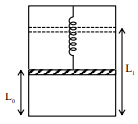
A piston of mass MM is hung from a massless spring whose restoring force law goes as F=kxF = -kx, where kk is the spring constant of appropriate dimension. The piston separates the vertical chamber into two parts, where the bottom part is filled with nn moles of an ideal gas. An external work is done on the gas isothermally (at a constant temperature TT) with the help of a heating filament (with negligible volume) mounted in lower part of the chamber, so that the piston goes up from a height L0L_0 to L1L_1, the total energy delivered by the filament is (Assume spring to be in its natural length before heating)

Vertical chamber with a piston attached to a spring from the top, lower part containing gas, initial piston height labeled L0 and final raised position labeled L1.
  • A

    3nRTln(L1L0)+2Mg(L1L0)+k3(L13L03)3nRT \ln \left( \frac{L_1}{L_0} \right) + 2Mg(L_1 - L_0) + \frac{k}{3} (L_1^3 - L_0^3)

  • B

    nRTln(L1L0)+Mg2(L1L0)+k4(L14L04)nRT \ln \left( \frac{L_1}{L_0} \right) + \frac{Mg}{2} (L_1 - L_0) + \frac{k}{4} (L_1^4 - L_0^4)

  • C

    nRTln(L1L0)+Mg(L1L0)+k4(L14L04)nRT \ln \left( \frac{L_1}{L_0} \right) + Mg(L_1 - L_0) + \frac{k}{4} (L_1^4 - L_0^4)

  • D

    nRTln(L1L0)+Mg(L1L0)+3k4(L14L04)nRT \ln \left( \frac{L_1}{L_0} \right) + Mg(L_1 - L_0) + \frac{3k}{4} (L_1^4 - L_0^4)

Answer

Correct answer:C

Step-by-step solution

Standard Method

Given: The process is isothermal at constant temperature TT for nn moles of an ideal gas. The piston rises from L0L_0 to L1L_1. The spring is initially at natural length.

Find: The total energy delivered by the filament.

For an ideal gas in an isothermal process,

ΔU=0\Delta U = 0

Hence, from the first law of thermodynamics,

ΔQ=W\Delta Q = W

So the energy delivered by the filament equals the work associated with the process.

The thermodynamic work term for the gas is

Wgas=nRTln(V1V0)W_{\text{gas}} = nRT \ln\left(\frac{V_1}{V_0}\right)

Since

V0=AL0,V1=AL1V_0 = AL_0, \qquad V_1 = AL_1

we get

Wgas=nRTln(AL1AL0)=nRTln(L1L0)W_{\text{gas}} = nRT \ln\left(\frac{AL_1}{AL_0}\right) = nRT \ln\left(\frac{L_1}{L_0}\right)

As the piston moves upward, energy is also associated with increase in gravitational potential energy of the piston and spring potential energy.

The gravitational term is

ΔPEgravity=Mg(L1L0)\Delta PE_{\text{gravity}} = Mg(L_1 - L_0)

Using the working shown in the solution, the spring contribution is taken as

ΔPEspring=L0L1kL3dL\Delta PE_{\text{spring}} = \int_{L_0}^{L_1} kL^3 \, dL

Therefore,

ΔPEspring=[kL44]L0L1=k4(L14L04)\Delta PE_{\text{spring}} = \left[ \frac{kL^4}{4} \right]_{L_0}^{L_1} = \frac{k}{4}(L_1^4 - L_0^4)

Thus the total energy delivered by the filament is

ΔQ=nRTln(L1L0)+Mg(L1L0)+k4(L14L04)\Delta Q = nRT \ln\left(\frac{L_1}{L_0}\right) + Mg(L_1 - L_0) + \frac{k}{4}(L_1^4 - L_0^4)

This matches option C.

Therefore, the correct option is C.

Work-Energy Balance View

Given: The piston rises from L0L_0 to L1L_1 under isothermal conditions.

Find: The total energy supplied by the filament.

From the work-energy viewpoint used in the provided hint, the supplied energy must account for:

  • increase in gravitational potential energy,
  • increase in spring potential energy,
  • isothermal work term of the gas.

So the expression becomes

Wext=Mg(L1L0)+k4(L14L04)+nRTln(L1L0)W_{\text{ext}} = Mg(L_1 - L_0) + \frac{k}{4}(L_1^4 - L_0^4) + nRT \ln\left(\frac{L_1}{L_0}\right)

The same final expression appears in the second approach of the solution.

Hence, the energy delivered by the filament is

nRTln(L1L0)+Mg(L1L0)+k4(L14L04)nRT \ln\left(\frac{L_1}{L_0}\right) + Mg(L_1 - L_0) + \frac{k}{4}(L_1^4 - L_0^4)

So the correct option is C.

Common mistakes

  • Using ΔQ=0\Delta Q = 0 for an isothermal process is incorrect. For an ideal gas, isothermal implies ΔU=0\Delta U = 0, not zero heat. Use ΔQ=W\Delta Q = W instead.

  • Ignoring the gravitational potential energy of the piston gives an incomplete energy balance. The piston mass MM rises by L1L0L_1-L_0, so the term Mg(L1L0)Mg(L_1-L_0) must be included.

  • Taking the logarithmic work term as nRTln(L0L1)nRT \ln\left(\frac{L_0}{L_1}\right) reverses the sign. Since the height and hence volume change from L0L_0 to L1L_1, use nRTln(L1L0)nRT \ln\left(\frac{L_1}{L_0}\right).

Practice more Isothermal & Adiabatic Processes questions

Get unlimited AI-adaptive practice, mastery tracking, and an AI tutor that explains every step — free to start.

Related questions