
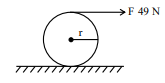
A force of acts tangentially at the highest point of a sphere (solid) of mass , kept on a rough horizontal plane. If the sphere rolls without slipping, then the acceleration of the center of the sphere is
- A
- B
- C
- D
A force of acts tangentially at the highest point of a sphere (solid) of mass , kept on a rough horizontal plane. If the sphere rolls without slipping, then the acceleration of the center of the sphere is
Correct answer:A
Standard Method
Given: A tangential force acts at the highest point of a solid sphere of mass on a rough horizontal plane. The sphere rolls without slipping.
Find: The acceleration of the center of the sphere.
For linear motion along the horizontal direction,
where is the static friction.
For rotational motion about the center of mass,
For a solid sphere,
and for rolling without slipping,
So,
which gives
Now add the two equations:
Hence,
Substituting the given values,
Therefore, the acceleration of the center of the sphere is . The correct option is A.
Torque About Contact Point
Given: The sphere rolls without slipping under a force applied at the top.
Find: The acceleration of its center.
Take torque about the point of contact with the ground. Then friction gives no torque about that point.
For a solid sphere, moment of inertia about the contact point is
The applied force has lever arm , so
Thus,
With and ,
Therefore, the acceleration of the center is . This shortcut works because taking torque about the contact point removes the unknown friction term immediately.
Assuming friction acts opposite to motion without checking the rolling condition is incorrect. Here friction acts forward to maintain rolling without slipping. Always determine friction direction from the tendency of relative motion at the contact point.
Using the wrong moment of inertia is a common error. For a solid sphere, , not or . Use the correct standard value before substituting.
Writing the torque equation with the same sign for force and friction is wrong. The applied force and friction produce torques in opposite rotational senses about the center. Assign torque signs consistently before solving.
Get unlimited AI-adaptive practice, mastery tracking, and an AI tutor that explains every step — free to start.