MCQMediumJEE 2025Capacitors & Dielectrics

JEE Physics 2025 Question with Solution

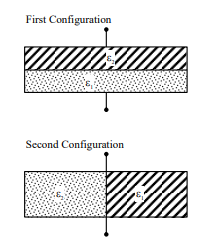
A parallel plate capacitor is filled equally (half) with two dielectrics of dielectric constant ϵ1\epsilon_1 and ϵ2\epsilon_2, as shown in figures. The distance between the plates is dd and area of each plate is AA. If capacitance in first configuration and second configuration are C1C_1 and C2C_2 respectively, then C1C2\frac{C_1}{C_2} is:

Two capacitor configurations are shown. In the first, two dielectric slabs of constants epsilon one and epsilon two are stacked across half the separation each. In the second, the slabs occupy half the plate area each side by side.
  • A

    ϵ1ϵ2(ϵ1+ϵ2)2\frac{\epsilon_1 \epsilon_2}{(\epsilon_1 + \epsilon_2)^2}

  • B

    4ϵ1ϵ2(ϵ1+ϵ2)2\frac{4\epsilon_1 \epsilon_2}{(\epsilon_1 + \epsilon_2)^2}

  • C

    ϵ1ϵ2ϵ1+ϵ2\frac{\epsilon_1 \epsilon_2}{\epsilon_1 + \epsilon_2}

  • D

    ϵ0(ϵ1+ϵ2)2\frac{\epsilon_0 (\epsilon_1 + \epsilon_2)}{2}

Answer

Correct answer:B

Step-by-step solution

Standard Method

Given: A parallel plate capacitor is half-filled with dielectric constants ϵ1\epsilon_1 and ϵ2\epsilon_2 in two different configurations. Let

C0=ϵ0AdC_0 = \frac{\epsilon_0 A}{d}

Find: The ratio C1C2\frac{C_1}{C_2}.

For the first configuration, the two dielectric parts divide the separation into two equal parts d2\frac{d}{2}, while the area remains AA. Hence the arrangement is equivalent to two capacitors in series.

C=ϵ2ϵ0Ad/2=2ϵ2ϵ0Ad=2ϵ2C0C = \frac{\epsilon_2 \epsilon_0 A}{d/2} = \frac{2\epsilon_2 \epsilon_0 A}{d} = 2\epsilon_2 C_0 C=ϵ1ϵ0Ad/2=2ϵ1ϵ0Ad=2ϵ1C0C' = \frac{\epsilon_1 \epsilon_0 A}{d/2} = \frac{2\epsilon_1 \epsilon_0 A}{d} = 2\epsilon_1 C_0

Since these are in series,

C1=CCC+CC_1 = \frac{CC'}{C + C'} C1=(2ϵ2C0)(2ϵ1C0)2ϵ2C0+2ϵ1C0C_1 = \frac{(2\epsilon_2 C_0)(2\epsilon_1 C_0)}{2\epsilon_2 C_0 + 2\epsilon_1 C_0} C1=4ϵ1ϵ2C022C0(ϵ1+ϵ2)=2ϵ1ϵ2C0ϵ1+ϵ2C_1 = \frac{4\epsilon_1 \epsilon_2 C_0^2}{2C_0(\epsilon_1 + \epsilon_2)} = \frac{2\epsilon_1 \epsilon_2 C_0}{\epsilon_1 + \epsilon_2}

For the second configuration, the two dielectrics divide the plate area into two equal parts A2\frac{A}{2}, while the separation remains dd. Hence the arrangement is equivalent to two capacitors in parallel.

C=ϵ1ϵ0A2d=ϵ1C02C = \frac{\epsilon_1 \epsilon_0 A}{2d} = \frac{\epsilon_1 C_0}{2} C=ϵ2ϵ0A2d=ϵ2C02C' = \frac{\epsilon_2 \epsilon_0 A}{2d} = \frac{\epsilon_2 C_0}{2}

Since these are in parallel,

C2=C+C=ϵ1C02+ϵ2C02=(ϵ1+ϵ2)C02C_2 = C + C' = \frac{\epsilon_1 C_0}{2} + \frac{\epsilon_2 C_0}{2} = \frac{(\epsilon_1 + \epsilon_2)C_0}{2}

Now take the ratio:

C1C2=2ϵ1ϵ2C0ϵ1+ϵ2(ϵ1+ϵ2)C02\frac{C_1}{C_2} = \frac{\frac{2\epsilon_1 \epsilon_2 C_0}{\epsilon_1 + \epsilon_2}}{\frac{(\epsilon_1 + \epsilon_2)C_0}{2}} C1C2=2ϵ1ϵ2C0ϵ1+ϵ2×2(ϵ1+ϵ2)C0\frac{C_1}{C_2} = \frac{2\epsilon_1 \epsilon_2 C_0}{\epsilon_1 + \epsilon_2} \times \frac{2}{(\epsilon_1 + \epsilon_2)C_0} C1C2=4ϵ1ϵ2(ϵ1+ϵ2)2\frac{C_1}{C_2} = \frac{4\epsilon_1 \epsilon_2}{(\epsilon_1 + \epsilon_2)^2}

Therefore, the correct option is B.

Series and Parallel Interpretation

Given: In one arrangement, the dielectric slabs are stacked along the plate separation; in the other, they are placed side by side along the plate area.

Find: The ratio C1C2\frac{C_1}{C_2}.

Use the capacitor formula

C=Kϵ0AdC = \frac{K\epsilon_0 A'}{d'}

where KK is the dielectric constant, AA' is the effective area, and dd' is the effective separation.

In the first configuration, each dielectric occupies thickness d2\frac{d}{2} with full area AA. So the two capacitances are

C1a=ϵ1ϵ0Ad/2=2ϵ1ϵ0AdC_{1a} = \frac{\epsilon_1 \epsilon_0 A}{d/2} = \frac{2\epsilon_1 \epsilon_0 A}{d} C1b=ϵ2ϵ0Ad/2=2ϵ2ϵ0AdC_{1b} = \frac{\epsilon_2 \epsilon_0 A}{d/2} = \frac{2\epsilon_2 \epsilon_0 A}{d}

These are in series, so

1C1=1C1a+1C1b\frac{1}{C_1} = \frac{1}{C_{1a}} + \frac{1}{C_{1b}} 1C1=d2ϵ1ϵ0A+d2ϵ2ϵ0A\frac{1}{C_1} = \frac{d}{2\epsilon_1 \epsilon_0 A} + \frac{d}{2\epsilon_2 \epsilon_0 A} 1C1=d2ϵ0A(1ϵ1+1ϵ2)\frac{1}{C_1} = \frac{d}{2\epsilon_0 A}\left(\frac{1}{\epsilon_1} + \frac{1}{\epsilon_2}\right)

Hence,

C1=2ϵ0Ad(ϵ1ϵ2ϵ1+ϵ2)C_1 = \frac{2\epsilon_0 A}{d}\left(\frac{\epsilon_1\epsilon_2}{\epsilon_1 + \epsilon_2}\right)

In the second configuration, each dielectric occupies area A2\frac{A}{2} with full separation dd. So the two capacitances are

C2a=ϵ1ϵ0(A/2)d=ϵ1ϵ0A2dC_{2a} = \frac{\epsilon_1 \epsilon_0 (A/2)}{d} = \frac{\epsilon_1 \epsilon_0 A}{2d} C2b=ϵ2ϵ0(A/2)d=ϵ2ϵ0A2dC_{2b} = \frac{\epsilon_2 \epsilon_0 (A/2)}{d} = \frac{\epsilon_2 \epsilon_0 A}{2d}

These are in parallel, so

C2=C2a+C2b=ϵ0A2d(ϵ1+ϵ2)C_2 = C_{2a} + C_{2b} = \frac{\epsilon_0 A}{2d}(\epsilon_1 + \epsilon_2)

Now,

C1C2=2ϵ0Ad(ϵ1ϵ2ϵ1+ϵ2)ϵ0A2d(ϵ1+ϵ2)\frac{C_1}{C_2} = \frac{\frac{2\epsilon_0 A}{d}\left(\frac{\epsilon_1\epsilon_2}{\epsilon_1 + \epsilon_2}\right)}{\frac{\epsilon_0 A}{2d}(\epsilon_1 + \epsilon_2)} C1C2=4ϵ1ϵ2(ϵ1+ϵ2)2\frac{C_1}{C_2} = \frac{4\epsilon_1\epsilon_2}{(\epsilon_1 + \epsilon_2)^2}

Thus, the required ratio is 4ϵ1ϵ2(ϵ1+ϵ2)2\frac{4\epsilon_1\epsilon_2}{(\epsilon_1 + \epsilon_2)^2}, which corresponds to option B.

Common mistakes

  • Treating the first configuration as a parallel combination is incorrect because the dielectric slabs are stacked along the separation, so the electric field passes through one slab and then the other. Model it as a series combination instead.

  • Using area AA instead of A2\frac{A}{2} in the second configuration gives the wrong capacitance. In that arrangement, each dielectric covers only half the plate area, so each individual capacitor must use area A2\frac{A}{2}.

  • Using separation dd instead of d2\frac{d}{2} in the first configuration is wrong. Each dielectric occupies only half the gap between the plates, so each capacitor in the series model has separation d2\frac{d}{2}.

Practice more Capacitors & Dielectrics questions

Get unlimited AI-adaptive practice, mastery tracking, and an AI tutor that explains every step — free to start.

Related questions