
The number of solutions of the equation , is
- A
- B
- C
- D
The number of solutions of the equation , is
Correct answer:B
Standard Method
Given: with .
Find: The number of solutions in the given interval.
Rearrange the equation as
Let
So we need the number of intersection points of the graphs of and in the given interval.
The function has vertical asymptotes at
and is a straight line with slope and intercept .
The interval is split into
By sketching the graphs or analyzing their behavior on each interval, we observe a total of intersection points.
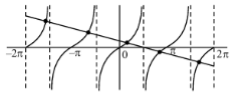
Therefore, the number of solutions is . Hence, the correct option is B.
Interval-wise Graph Analysis
Given: .
Find: Count the solutions for .
Since is undefined at and , the interval is divided into regions separated by these points.
In each interval of the form
we know that increases from to . The equation
can therefore be studied by looking at intersections of the curve with the constant level , or equivalently by comparing with the line .
Checking the regions
Thus, the correct answer is , so the correct option is B.
Counting the excluded points and as valid solutions is incorrect because is undefined there. These points only split the interval; they cannot satisfy the equation.
Assuming one solution in every tangent branch without checking the finite domain is wrong. The end intervals near and are truncated, so the count must be made only inside the given interval.
Trying to solve the equation algebraically in closed form and abandoning the graph is a mistake. Here, the intended method is to compare with a straight line and count intersections interval by interval.
Get unlimited AI-adaptive practice, mastery tracking, and an AI tutor that explains every step — free to start.